Sugar Comes From Arabic

Nothing melts my heart so thoroughly as receiving a kind letter from a favorite author.

sugar.comes.from.arabic

Recently, I suggested, kind readers, that you visit a link to a valuable resource. To a book that inspired me to learn Arabic well — Sugar comes from Arabic by Barbara Whitesides. It is as sweet as Arabic coffee. I encourage you to obtain a copy as early as humanely possible.

Select a tea or Arabic coffee and get ready to savor marvelous things. Fetch a writing instrument and some lined paper, or the back of an envelope. The book is comfortable to the eagerly flipping hand. Very often overlooked by lesser binders — it has a freely moving ring-binder format. Lay it open, lay it to one page. It doesn’t fall to the floor. It doesn’t require paper weights — a very important feature in a language book!

Discover a world where mere writing takes on the freedom and skill of the gymnast. A language a world away from the 26 offerings of the English you are reading now.  Latin letters of Roman device (Latin Alphabet A-Z).

qawa

Did you know that a proper Latin alphabet possesses not the merest of minuscules? Have you observed that curved lines are quite literally ANATHEMA to the words of Latin? Writing with ALL CAPS connotes shouting in the language Troll.

Somehow I feel it likely that you are reading this while attached to the internet.

Might you have read this far, I admire your patience. Perhaps you’ve only now viewed this olde bloge o’ mine. I thank you for reading, and I’ll thank you again at the end of this post.

Roman numerals are now seen at the opening frames of older films, e.g. MCMIX (quite a number of famous Hollywood releases in 1939 (to have already given away conversion of MCMIX). The only other use is to promote a bowl of befouled fowl body parts in the cold cave of early February.

Proceed you now to several pages:

sugar.k

Mnemonics aids learning, it’s one way to hold onto fragile new knowledge while it attempts to land safely and securely in long-term memory.

Here I am quoting myself in a letter to Barbara —

Quote:

Your kind letter has made my year 🙂 Thank you so much for reading my article. You never know just how far your words can travel.
I am writing a series on my discoveries in Arabic and I want to share how much Sugar Comes from Arabic helped me overcome the daunting challenge that mastering its script represented. Now I find myself enthralled by each encounter — from the unexpected thrill of gently pulling the pen along the paper rather than plowing into the paper, then immediately covering it up in the “normal” way that my left-handedness dictates in left-to-right English.
I taught German for many years and know how limited and mundane many methodologies simply are. Bringing language alive doesn’t just happen. My introduction to Arabic began with one of my Palestinian students. I still have the slip of paper that became my introduction. Finding your book was the next discovery that piqued my interest and resolve to keep at it.
Well it seems that I am already writing the next in that series of Arabic discoveries by composing this reply. So I return to the SaFaRi into the desert that is the blank page — a SaHaRa 🙂

:End Quote

Let’s check out another page:

sugar.j.png

Here’s a rhetorical question: Why do so many books on Arabic use small and grainy fonts?

Arabic script is a joy. Barbara Whitesides’ book is both beautiful and inspiring.

Thanks for reading.

Sid Caesar — A Language for all Seasons

Sid Caesar died in 2014 at age 91. A pioneer in the gentler arts of subtle humor, Caesar approached his craft with an inquisitive spirit and intellectual curiosity — you can’t do that without patience and discipline. He listened to rhythms and song, he could mime anything animate or inanimate. Though able to transmit the theater of language, his only two tongues were English and Yiddish.

sid-caesar

All languages are indeed songs. Iambic pentameter is, quite simply, the cadence of spoken English. In my opinion a haiku never sounds right in English because the Japanese haiku does not transplant well in foreign soil.

From the Caesar, not the one known for “Gallia est omnis divisa in partes tres”:

“I didn’t allow cue cards because, to my mind, when you’re acting with someone you listen when they speak, … Because then you can push off not just what they say but how they say it. You don’t just hang around waiting for your cue.”

Translation is a gentle art,  all translations are rough estimations. Something is always lost in the translation. In the hands of the demagogue language is a weapon to leverage propaganda. Agendas render translations that wish to mislead — always, or at least often enough.

Poetry resists translation intensely. But that is as it should be — poems are distilled language, translation muddies and soils.

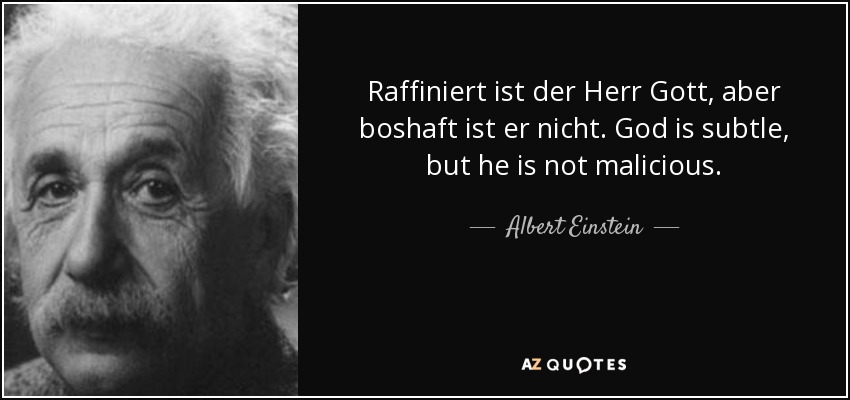
quote-raffiniert-ist-der-herr-gott-aber-boshaft-ist-er-nicht-god-is-subtle-but-he-is-not-malicious-albert-einstein-90-85-72

By my own estimation an oft repeated remark by Albert Einstein is not a good enough translation of the German. A wise man once hadn’t said…

The German:  Raffiniert ist der Herrgott aber boshaft ist er nicht

The most common render: Subtle is the Lord, but malicious he is not.

A single word change: Mischievous is the Lord, but malicious he is not.

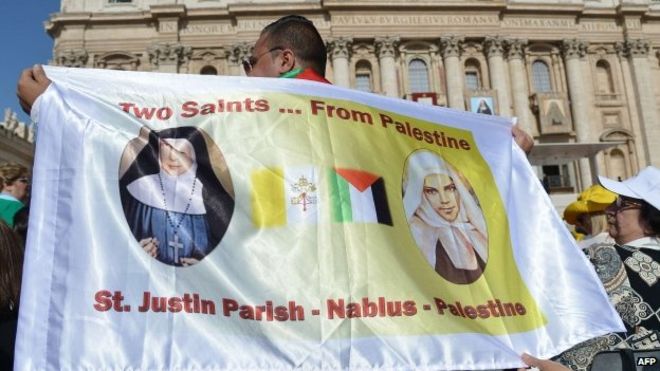
I think it’s good alliteration. Well, I may be outnumbered, but isn’t it an improvement on the more clumsy subtle/malicious. Perhaps I’m guilty of some degree of bias when taking sides with my own blog. With a nod to a rare public voice (hint: Habemus papam — “who am I to judge.”)
2-saints-from-palestine
Movements to excommunicate — or at least exile — Pope Francis are loud, vociferous and growing with brute fervor.
Listening patiently is among the lost arts. The sentient fellow-being in your presence deserves your attention — it’s that breathtakingly short moment when they may reach and teach you. Carpe diem!
Okie dokie, let’s consider another quote from Mr. Caesar:
The remote control changed our lives, … The remote control took over the timing of the world. That’s why you have road rage. You have people who have no patience, because you got immediate gratification. You got click, click, click, click. If it doesn’t explode within three seconds, click click, click.
~ Sid Caesar (from Successories)
When it comes time for you to speak, do not use your words as weapons but as tools for removing barriers, widening perspectives and sharing a planet where homo sapiens is the sole responsible specie threatening to drop another extinction event on all and each.
 Be also wary of weaponized symbols and icons, my impertinent opinion of course.
Thanks for reading.

A SaFaRi into the SaHaRa

My last detour took us to a Picnic (pique-nique in French) in 1934 Grange, Pennsylvania. Here is a footnote to that previous post has ended up in the opening paragraph for this post. You may not have wondered about the Yiddish word shtick . It’s from the German noun Stück (a piece).  

What’s your shtick, Bill?

Yakking  on about different ways to yak away. 

There is just something exhilarating about learning languages. aha-momentHere are three (3) remarkable benefits: 

  1. remove barriers,
  2. erase borders and, if fortune favors,
  3. become less baffled

We’re glad that you are taking a safari into the Sahara. Please tell us less.

Root letters in Arabic do something quite curious. They occur in an ordained order. Here is a root you may have noticed in the title  — SFR. Arabic dictionaries segment meaning through a root system. Grab that Arabic dictionary over there and flip away until you’ve encounter SFR,  see below.

2-%d8%b3%d9%81%d8%b1-sfr

Don’t forget to read from right to left.

Bill, are you going to tell us about a book that teaches Arabic with aplomb?

Yes.

I want to share how much Sugar Comes from Arabic by Barbara Whitesides helped me master Arabic, and have a rollicking time at the same time. It’s an amazingly beautiful ring-bound volume that is simply delightful. As with all my reviews, I just want to pass on good words for great works. It’s what teachers do.

Calligraphy is one of those hobbies I’ve hobbled through with my left-hand. Now I can’t overestimate the unexpected thrill of gently pulling the pen along my paper — no plowing into the paper, or covering up writing while writing.  You may have noticed that English is written from left-to-right.

Let us consider prefixes, suffixes and diacritical marks. Hey you say, there are bunches of words having such and much to do with “travel” in Arabic — words like safari.Hey I say, the Arabic root for desert is SHR. Technically, the Sahara Desert suggests Desert Desert. Here is a fun web page for those wanting yet another resource on Arabic verb forms.sahara

Well that was breathtakingly tedious, but we needed to yawn in order to dispel stale air. But you were heading into a desert, please proceed.

Interesting innit?


Here’s another innit —

arabic-sound-heuristic
Here is a useful diagram for associating alphabet whats and wheres. I’ve found it helpful for distinguishing the “sun and moon” letters in Arabic.

Didn’t you write a toss-off post a while back — just trying to change the subject.

Yes — Sudden solitude in a crowded desert, based on a line from T.S. Eliot’s The Family Reunion.

Thanks for reading.


Losing Rumi in the Translation

A couple years ago I attended an interfaith discussion at Christ Church Cathedral in Cincinnati: “Welcoming the Stranger.” Their guest, Ismaeel Chartier of the Clifton Mosque, spoke to this theme. One attendee literally thumped a Qu’ran on a table and demanded an answer of Chartier:

“Do you know what is written in this book?”

He delivered this inquiry with a sharp accusatory tone. Then he gave the Qur’an interpretation another thump.

The Imam calmly replied:

“It depends on the translation.”

dua

Translation is a science, it’s an art, and there’s a lot at stake. Interpretations that serve a trenchant agenda may wish to cloud understanding, to close open minds. This is an odious breach of ethics and a declaration of cultural militance. An imperious position that lusts power. Most Muslims are not Arabs, but each adherent relies upon a faithful transmittal of the Word in Arabic language. It is in the marrow of Islam.

Simple answers to complex societal questions are wrong-headed and arrogant, but they are widely believed and have entered the body politic like a body-blow.

Yesterday I happened upon an article in the The New Yorker on the inescapably important Persian poet Jalāl ad-Dīn Muhammad Rūmī . Coleman Barks is a decades-long lover of Rūmī, but it is unfortunate that his is an interpretation that informs his Christian upbringing. Barks is not disingenuous in working the poet through that innate filter, but the heart of Rūmī speaks to Islam — the faithful focus of his heart and being is integral.

rumi-calligraphic

From the article:

Rūmī is often called a mystic, a saint, an enlightened man. He is less frequently described as a Muslim.”

Source: The Erasure of Islam from the Poetry of Rumi – The New Yorker

Memes that attribute heartfelt insight through search-engine algorithms often misattribute, mistranslate, misinform. Truth becomes an early victim. Allow me to repeat the oft repeated:

“Everyone is entitled to his own opinion, but not his own facts.”

This quote is attributed to Daniel Patrick Moynihan, a voice much worth hearing. But this very popular attribution adopted by innumerable memes is not sourced to Moynihan.

lies

To quote the late and astonishing John Ciardi: writer and world-class translator of Dante.

“Good Words to You.”

irvine-welsh
As an incurable pedant I assign vetting this quote as a reading assignment 🙂

Thanks for reading.