Read by Number or Color by Number?

Before nano-processors in your pocket did all the memorizing for you, back in 1974, a fad whispered and died before anyone knew it existed — memorizing numbers for profit and fun. I wasn’t interested in fun and profit, nor in memorizing my mother-in-law’s phone number,  but I was interested in reading numbers. To cut to the rabbit hole, the concept piqued an interest that is still peaking..

Parlor tricks interest me less than basketball in a mad enough March.

Any of the way, it’s formally known as the Major System.

Bill, you major in minor interests don’t you?

You are correct, Sir. The more arcane and uninteresting the endeavor, the more profound my fascination.

Let’s say you have trouble remembering an all-important number — such as 42.

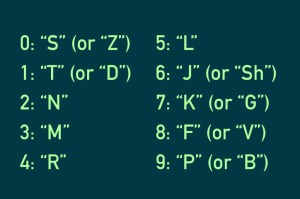
The sound of a 4 is R. The sound of a 2 is N. RN ran Iran ron run rune rain
Major-System

But what if you need to remember your towel and don’t have a word/number number/word dictionary at hand. Problemo No-o. W counts as a consonant in Arabic, but not in the language of System-Major.

Identify two (2) consonants — T and L. T sound denotes 1. L sound denotes 5.

15

Vowels are not explicitly expressed, so choose the consonantal combo that works for you.

Now turn your word-number/number-word dictionary upside down and look up the number 15. What have we there? What have we?
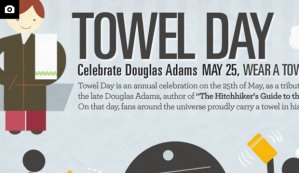
towel.day

Let me explain something — the number 1 can be a T, the number 1 can be a D. This is something I call the Ta Da phenomenon.

But Bill, does this have anything to do with German language?

Of course it does. When I taught German (a lot) it seemed important to invent a hokey-butt theory to explain similarities between German and English. My theory posits that the original Saxons, on their way to the British Isles, decided to celebrate their immigration by tweaking German into something that could become English. They did this en route. No one has ever reported this language-building event for the simple reason that none of it actually happened.

Map-England-Invasions_c

Are you trying to say something, Bill? You lost us in Calais.

Yeah. The language-building team chose phonetically related consonants to do stuff like. I’m like, like you know, like instead of UTTER like say like UDDER — just to be different I guess.

Bill. We’re in the other room watching madness march, we can’t hear you. Titter, titter.

Tidder, tidder.

Let us look at another pair here: B to V.

Über-over oben-above eben-even.

Wer hat eine Frage? (Does anyone have a question?)

Could you close the door, Bill. We’re watching the game.

Thanks for reading.

Sid Caesar — A Language for all Seasons

Sid Caesar died in 2014 at age 91. A pioneer in the gentler arts of subtle humor, Caesar approached his craft with an inquisitive spirit and intellectual curiosity — you can’t do that without patience and discipline. He listened to rhythms and song, he could mime anything animate or inanimate. Though able to transmit the theater of language, his only two tongues were English and Yiddish.

sid-caesar

All languages are indeed songs. Iambic pentameter is, quite simply, the cadence of spoken English. In my opinion a haiku never sounds right in English because the Japanese haiku does not transplant well in foreign soil.

From the Caesar, not the one known for “Gallia est omnis divisa in partes tres”:

“I didn’t allow cue cards because, to my mind, when you’re acting with someone you listen when they speak, … Because then you can push off not just what they say but how they say it. You don’t just hang around waiting for your cue.”

Translation is a gentle art,  all translations are rough estimations. Something is always lost in the translation. In the hands of the demagogue language is a weapon to leverage propaganda. Agendas render translations that wish to mislead — always, or at least often enough.

Poetry resists translation intensely. But that is as it should be — poems are distilled language, translation muddies and soils.

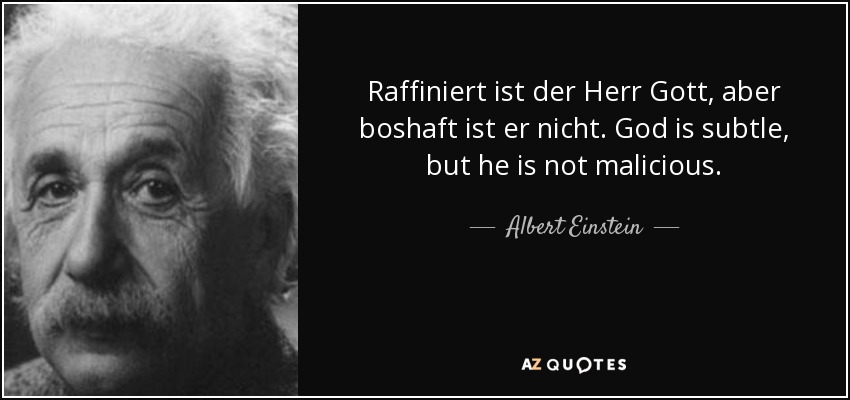
quote-raffiniert-ist-der-herr-gott-aber-boshaft-ist-er-nicht-god-is-subtle-but-he-is-not-malicious-albert-einstein-90-85-72

By my own estimation an oft repeated remark by Albert Einstein is not a good enough translation of the German. A wise man once hadn’t said…

The German:  Raffiniert ist der Herrgott aber boshaft ist er nicht

The most common render: Subtle is the Lord, but malicious he is not.

A single word change: Mischievous is the Lord, but malicious he is not.

I think it’s good alliteration. Well, I may be outnumbered, but isn’t it an improvement on the more clumsy subtle/malicious. Perhaps I’m guilty of some degree of bias when taking sides with my own blog. With a nod to a rare public voice (hint: Habemus papam — “who am I to judge.”)
2-saints-from-palestine
Movements to excommunicate — or at least exile — Pope Francis are loud, vociferous and growing with brute fervor.
Listening patiently is among the lost arts. The sentient fellow-being in your presence deserves your attention — it’s that breathtakingly short moment when they may reach and teach you. Carpe diem!
Okie dokie, let’s consider another quote from Mr. Caesar:
The remote control changed our lives, … The remote control took over the timing of the world. That’s why you have road rage. You have people who have no patience, because you got immediate gratification. You got click, click, click, click. If it doesn’t explode within three seconds, click click, click.
~ Sid Caesar (from Successories)
When it comes time for you to speak, do not use your words as weapons but as tools for removing barriers, widening perspectives and sharing a planet where homo sapiens is the sole responsible specie threatening to drop another extinction event on all and each.
 Be also wary of weaponized symbols and icons, my impertinent opinion of course.
Thanks for reading.

Teitsch Deitsch

The time has come, the ziegler said, to speak of many things, or perhaps just about Teitsch and Deitsch.

yiddish
Yiddish borrowings — from Teitsch

Yiddish is a rendering of the German word Jewish — ‘Jüdisch‘.  This evening I took another look at it. A German might say ‘Such’ (but pronounce it ‘zook’) – ich suche einen neuen Look (I’m looking for a new look).

Where did you look, Bill? And, by the bye, we despise digression. And we’re easily unamused.

Among the less traveled crannies and nooks, under rocks or falling from trees. The usual haunts.

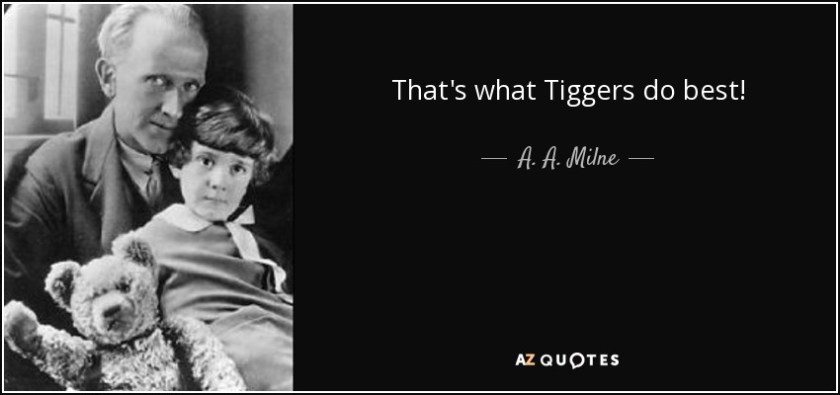
I’m the kind of person that spends moments thinking about the structure of German language — the gleanings of such squandered moments might help explain the resilience of languages based on German — things that Tiggers do best.

tiggers-do-best

Here’s my tentative thesis: German is so god-awful complicated and rigid that it remains recognizable to the speaker of modern Deutsch, by dint of complexity.

So you posit that it is a durable language — rigorously so. 

The Engländer spoke a form of German brought from Saxony (Sachsen), but the proverbial original German was jostled so thoroughly by the Vikings that all the inflections fell off.

Well at least I’ve anchored that reference to ‘things falling from trees.’

Do you speak Yiddish, Bill?

I can very easily understand the transliterated and the spoken Yiddish, i.e. without the Hebrew letters. It’s as familiar as Swedish or Dutch subtitles for a German film. In fact, Yiddish adopts German sounds and word order. Take a look and listen to the Omniglot site for a timely example.

heimish-101

Profile of an Endangered Language

Might we have a piece of birther cake?

A word from our sponsor:

Beware the big lie, the humorless, the enforcer of arbitrary rules, the racist, maker of rules for jazz performers. In short, never underestimate the threat of fascism. Only 15% of its speakers survived the Holocaust. Of the surviving speakers 10% live in New York, many by way of Ellis Island.

Why doesn’t the current President of the United States ever laugh? Or is that a ludicrous question?

We now return you to our regularly scheduled program, in progress.

Do you speak Pennsylvania Deitsch, Bill?

Those immigrants from the 18th century brought their language of origin.  Deitsch is a spoken language with several transliterations to mime the sound. Yet, the structure, word order and vocabulary survive with amazing fidelity. Interesting stuff

padutch1934picnic

Hiwwe wie Driwwe (a Deitsche newspaper)

On a related topic, what kind of beach books do you read?

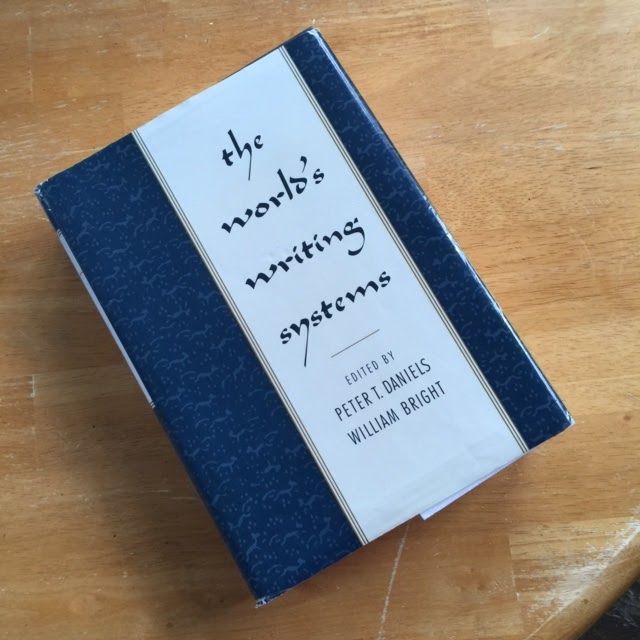
Here is an out-of-print volume that I found at a local library discard sale for 50 cents.  

The World’s Writing Systems by Peter T. Daniels and William Bright

the-worlds-writing-systems

Here is that very book on archive.org

Thanks for reading.


Arabic: what gives?

Many posts ago a Palestinian pal (“pal” is twitterese for Palestinian) asked me to write about my adventures in Arabic. So here ’tis 🙂

lemon

you-already-speak-arabic-arabic-loanwords-in-european-languages-9-728

This pal o’ mine is a refugee of Nakba 1948. By various twists of synchronicity he found his way to one of my German classes, intent on reading a bit of the curious language.

What resulted?

A capital stroke of good fortune — a safari if you will. And so did it begin. I said “look my friend, if you are willing to learn some German I could at least learn some Arabic.”

Arabic script is daunting at first. I compare its foundation in the arts and sciences to the Roman alphabet: Arabic script is to the Latin alphabet what Arabic numerals are to Roman numerals.

A qualitative difference?

Take a Roman number. Calculate its root. Let’s take the most important number of all time 42 (XLII). Let me know when you have an answer. Show all work.

match-stick-pi

Nevertheless, Roman civil engineers achieved the splendor of the arch and its keystone cap.

I bet you didn’t know Farsi from Arabic at first.

That is actually correct. I looked at Persian and thought the pairing would be simple — like switching to Dutch from German. Well, a well of Arabic words exist  in Farsi, but Farsi is not based on the root system, a method residing at the very foundation of Arabic. It’s closer to English that way. Rootless.

arabic-or-farsi

Well well well. WTF is a root system?

Consonants that appear in a certain order to suggest meaning. The word ‘safari‘ has roots od SFR. Place some prefixes, suffixes and a few vowel sounds here and there. You’ll discover vocabulary treasures relating to ‘travel’ one way or another.

Why did your pal bleed from the ears?

Not just my friend — most of my students. Encounters with German involve a crazy  grammar that most German students to long for escape (The Great Escape). Though toddlers who drop every dread adjective ending perfectly every day — imagine tossing a deck of cards into the air and thinking them into well sequenced suits.

german-article-adjective-and-pronoun-chart-updated

What’s the deal with Arabic grammatical gender?

Look for a taa marbuta at the end of a noun — it’s that smiley face you see to the right, it’s easy to recognize too.

ta-marbuta

Arabic nouns are never neuter. There is no “it.” Just masculine and feminine. Wowser, that’s a 50% increase, from 2 to 3. There is no verb “to be” in the present, though there is a “was” in Arabic. The verb “to have” does not exist in the way of “haben” or “have” or “habeo.” Habemus Papam.

Did you know that it’s almost impossible to say anything in German without knowinf a noun’s gender?

Only a small exaggeration.

Herr Ziegler, can you craft a short sentence containing all four cases for us?

Let me grapple that in another post.  Gellerese anyone?

gellerese5

Thanks for reading.