Dem German Endings

You may get PTSD, but learning German is a good way to learn the grammar you forgot — or the grammar you never learned. German is as fulsome as it is fulsome in that respect, something like a built-in sentence diagram.

There are 16 ways to say “the” in German. Just as there are 16 ways to say “the” in English?

No. Each of the 16 ways in German tell you the gender, number and case of the following noun. So just IN CASE…

Having taught the language for decades I’ve found some tricks for avoiding German’s paradigms from hell, that’s what they are — and no mistake. Something they don’t tell you about until it’s too late to drop the class, I am hoping that this post serves as warning. It may be too late for me, but not for thee.

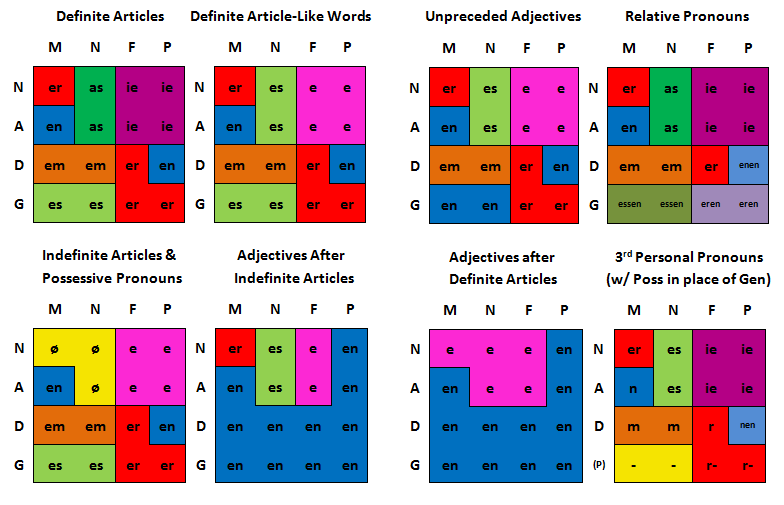
german-article-adjective-and-pronoun-chart-updated
I found this “visual aid” at the following site. It’s a genuine P-O-S in my humblest opinion — ein Stück Scheisse.

Take a look at the über busy “visual aid” to the right. It’s a genuine P-O-S in my humblest opinion — ein Stück Scheisse, ohne Zweifel.

Mark Twain learned German (Fraktur even!) and lived to warn his readers: The Awful German Language. Fraktur inventors even thought of making the letter ‘f’ nearly indistinguishable from the letter ‘s’. So that you have to recognize the damned words containing ‘f’ and ‘s’ before you can understand what you are reading? Yes.

Consider the first line that the crow below is about to peck. “This is the Leipzig Fraktur font”:

fraktur-font-copy

I didn’t begin learning German until becoming an adult, when I needed it to study in West Germany in 1971. Sheer good fortune found me rooming with the only German student in the building who did not speak English…

Okay, enough of that, enough of that. What’s this lesson plan you wish to share?

Before the Vikings invaded Britain, English was still inflected the Saxon (Sachsen) way. The German “chs” became the simplified “x”. They had a land to plunder, so they took the gordian option — replace all the sixteen shades of inflection for the so-called “strong endings”” from der, die, das, den, dem and des to “the” and replace all the twelve shades of inflection for the so-called weak endings” to “the” as well. Knot cut.

der.die.das.the

German inflections do not flourish in non-German soil well. Norway, Sweden, Denmark, Netherlands — all of them pretty much did away with the meaning-by-inflection technique and applied the Viking way. Similarly, the Romance languages discarded the five declensions of Latin.

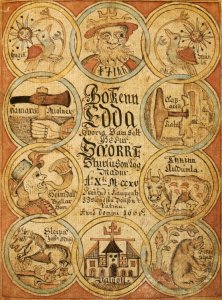
The only country that retained German (Nordic Branch) was Iceland. It has maintained all four cases and three genders for a millenium. Icelandic speakers can, with a bit of effort, read the Eddas. By the way, the Icelandic word for Iceland is Island — Iceland is land, is it not?
edda

Now then, how do those inflections work in German language? I’m calling the following lesson plan The Case of the “The” by Erle Stanley Gaertner:

  1. Über den Fluss und durch den Wald,
  2. Zu Großvaters Haus gehen wir;
  3. Die Pferde kennen den Weg, den Schlitten zu tragen
  4. trotz des dreckigen und tiefen Schnees.
  5. gegen den Regen und durch den Wald,
  6. zur Grossmutter und zum Grossvater gehen wir!
  1. Over [object of a preposition of relative position, accusative, masculine] river and through [preposition exclusively accusative, masculine, plural] wood,
  2. To Grandfather’s house we go;
  3. [subject, nominative, neuter, plural] horses know the way [direct object, accusative, masculine, plural] to carry [direct object, accusative, masculine, singular] sleigh
  4. Despite [object of a preposition governed by genitive, masculine, singular]white and drifted snow.
  5. Against [object of a preposition of relative position, accusative, masculine, singular] rain and through[object of a preposition governed by accusative, masculine, singular] wood,
  6. to [preposition and object of a preposition governed by dative, feminine, singular] grandmother and to [preposition and object of a preposition governed by dative, masculine, singular] grandfather we go!

Thanks for reading.

The Case of the Missing Article

The Case of the Missing Article by E. Stanley, the Gardener.

“In the days before the arrival of the cicadas, the frogs and the dreadnoughts, in the land of the dead, the gardener tended the garden green. Suddenly a shot rang out.”

The” is definite English, it’s been that way since the Vikings killed the sixteen ways the Saxons (Sachsen) spoke, ways always to denote nouns. A part of speech now dead in the Isles of the Brit, many eons afore days of present kind.

To the victor goes the grammar. “THE” spake the Viking, and it was so.

Word order reigns where inflection governs. Do away with inflection and you become a slave to word order. By good fortune I suffered the arrows and the slings of Latin in high school. An introduction to case-driven tongues, that’s what it was.

scribblers.sculptors.scribes
Wheelock’s Latin

I’ve since revived my high-school understanding of Latin via (a Latin preposition you understand) the Wheelock method. I think that it’s fun to discover unexpected similarities between German and Latin, ones that originated in Indo-European. The preposition “in” uses the same cases (dative and accusative) to denote intra and inter movement, respectively. Now that is what I call a good time. A grand substitute for the dreadnought of sports`. In very fact, I am extraordinarily ignorant of any iota embalmed as sport.

indo.european.migrations

I like to bounce around among crowds of languages, to weigh their lot for commonalities, patterns and purposes.

No writings remain of Indo-European, the common root tongue for hundreds of languages. A tongue spoken in a geography we now call Ukraine and vicinity.

The English word “scribe” finds origin in the German schreiben.

Schreiben — writing.

Scribe – writer, transcription, scrivener (of Bartleby fame).

bartleby

When teaching German I would often encounter worthy mnemonics to aid student learning. Once, while writing the German verb “beschreiben” on the blackboard I noticed that its English equivalent “to describe” possessed an unexpected aspect: pivot the round part around the vertical part of the letter “b”, the letter “d.”

b d b d

beschreiben/describe

rotate the “b” to fashion a “d”, rotate a “d” to fashion a “b.”

be de are inseparable prefixes that lend flavor and spice to a foundational word, such as schreiben or scribe. It’s also great fun to encounter such things — the stuff of useful heuristics.

Thanks for reading.


Die schreckliche Englische Sprache

N.B. I have not yet inserted a translation plug-in.

Why not, Bill?

I don’t want to crash this blog by pasting html code improperly.

Kommen wir gleich zur Sache — die Wikinger emigrierten von Sachsen nach England im Jahre 793, und sie hatten mit den eroberten Frauen und den zukünftigen Kindern sprechen wollen. Hör mal zu: die Wikinger konnten die ungeheueren komplizierten Endungen jedes Dingworts überhaupt nicht verstehen. Die Eroberer hatten eine Lösung schnell gefunden: zum Teufel mit den verdammten Endungen.

This is a thinly veiled attack upon the official language of the free world. What be your purpose here?

WikingerServiette

Wenn Sie English lesen können, schauen Sie den folgenden Link an:

How Vikings Changed the English Language: Morphology.

Interessanterweise fing die große Vokalverschiebung zur etwa gleichen Zeit an. So viel wurden dabei geändert, aber so passieren die alternativen Geschichten.

als ob

Stellen Sie mal vor: “als ob” habe ich in einem Glossar der literarischen Ausdrücken gefunden, zwar als eine Übersetzung des Konzepts von Samuel Colleridge:

the willing suspension of disbelief 

5 Buchstaben auf Deutsch gegen 31 auf Englisch. Finde ich den Unterschied super. Eine Sprache zu lernen ist ein Abenteuer anzufangen, meiner Meinung nach.

denken.sie.doch.selber
Bill, why did you choose a SHOUTING green font to threaten world order? We’re taking names.

Gern behaupte ich, dass man einen deutschen Text schneller als einen englischen Text lesen kann. Einfach erkläre ich den Urgrund dieser Behauptung — Schon beim ersten Wort erkennen wir die Funktion des ersten Wortes, z.B. “dem” muss unbedingt das indirekte Object signalisieren. Also, entweder Maskulin oder Neutrum, oder?

Quod erat demonstrandum.

So wurde “the” erfunden. Wortstellung muss jede Funktion, bzw. jeden Kasus erklären. Konnten Herr Wiking mit der Familie anreden.

Ich hoffe, dass die Leser dieses Dingsbums mein Thema genossen haben.


Those Effing German Endings

Useful foreign-language texts are good to find — I recommend library discard sales, where you can find great stuff for 50 cents or less. You can buy 300 of these for the price of a required text that you’re still paying for decades later. Actually, I spied a personal favorite: The World’s Writing Systems this way (see photograph below)

the-worlds-writing-systems
A 50-cent purchase

I lived an iconoclast’s dream for 20 years: a Saturday German class (10 to 12:30) to design a better way to learn German at the TriState German-American School: TSGAS. Our principal was happy if the students were happy. I have saved many lesson plans over the years — some of it archived from a Commodore 64. All four cases and all four genders — German handles plurals the same way as its three genders, it’s basically a fourth gender. And all by Thanksgiving holiday.

Had you elected the three-year sequence and its college textbook you wouldn’t learn about Genitive case until the third year. I don’t think you should wait that long. There are many misbegotten German textbooks out there: I found one that didn’t cover the second-person familiar until the second half of the book. How are you supposed to patch that in?

Paradigms are only useful if they are intuitive, and part of a wider heuristic. I am placing a link to an image of a very bad set of paradigms IMO rather than the actual image here because WordPress randomly selects images to accompany posts.

Learning German the same way that Germans learn English doesn’t work in the long run.  Actually it doesn’t work in the short run either, as I’ve learned from personal experience. Sometimes you just have to blast away the fossilized crud that accreted in your brain. Out damned crud!

Inflection is a big deal in highly inflected languages. Ignoring that big deal does not make the inflections go away. The problem only becomes larger if you do not tackle it.

inneren.schweine.hund

Translation: “Overcome the lazy dog inside you. What I learned from a marathon runner.”

The Saxons who invaded Britain brought all those inflections with them, but then the Vikings showed up and made short work of it. ’twas the birth of “The” and the need to use word order to indicate the function of each noun.

One of the first native German speakers my ears encountered in a Frankfurt of 1971 came from a five-year-old child. This Kindergärtners command of complex inflection was free and accurate. Was it some kind of trick? Were there paradigms on the refrigerator, or hanging from a mobile above his crib in 1968? The words flowed as intuitively much as that cat in the late Jack Ziegler (no relation) cartoon:


jack.ziegler.cat

German Gender

Gender is not extraneous.

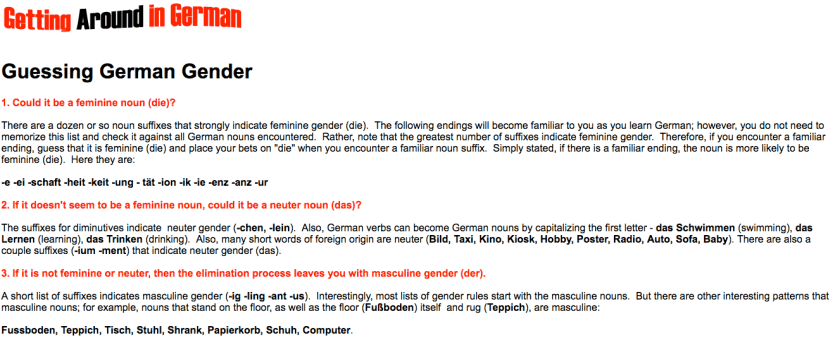
Most aids for learning gender suggest patterns for masculine nouns first. Don’t do that, feminine nouns are easier to learn than masculine nouns. Here is your handout:

Screenshot 2017-04-04 20.55.54

IMO it is better than the suggestions you’ll find in standard German textbooks, i.e. masculine first. So I say turn it upside down:

  1. Is it a feminine noun?
  2. No, then is it a neuter noun?
  3. In all probability it’s a masculine noun.

Am I the only German teacher who has noticed this cart in front of that horse?

Here is an exercise for practicing effing German endings at the dinner table. Unroll die Serviette and discover that spoon, fork and knife are, respectively masculine, feminine and neuter nouns — right there on the table. I’ll leave the plural forms for die Hausaufgabe (homework).

Screenshot 2017-04-04 19.14.55

By this point I have probably lost all but two of my readers. Thanks, you two — I am grateful 🙂

Now comes case in a nutshell:

  • Nominative signals subject, the gender you’ve just learned how to learn. Think four genders. You are 25% of the way there.
  • Accusative case differs from nominative only with single masculine nouns — the letter ‘n’ is a single vertical line away from ‘r’. All the others are the same as the nominative: die, das, die. You are halfway there.
  • Dative case — you are halfway to dative by realizing that the letter ‘m’ appears only with dative case nouns (masculine and neuter). You are three-quarters to the finish line.
  • Genitive case — masculine and neuter again: the ‘s’ you already know from English.

So you are left with the odd stragglers that now stand out in that 16 cell paradigm — the ‘der’ and the ‘den’.

Screenshot 2017-04-04 19.18.28

A takeaway: heuristics are fun, paradigms need context and a deliberate design. Here are some reasons:

heuristic

More to follow if you two readers are interested 🙂

Older posts on German language

Thanks for reading.