Arabic Script or Latin Alphabet: What Gives?

Arabic is a subtle language with a script that flows from right to left one millimeter at a time. Arabic sounds originate from vocal chord to the tip of the tongue, each brings slight variations in tone, in duration — these determine intent, what you seek to share. Meaning relies on accurate spoken and written construction.

It’s also a shape-shifter. Each letter may morph in four ways — a single letter may assume four forms, yet remain as unambiguously and reliably distinguishable as a pattern-matching schema. Examine the Arabic letter nunn (“n”):
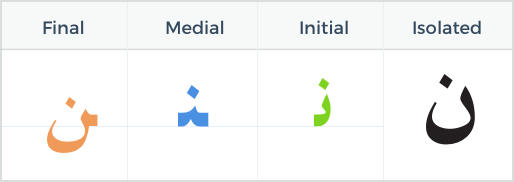
nun
Unambiguous after all, is it not?

Arabic describes those slight but significant sound variations with a dozen diacritical marks, then it permits one to double those diacritics when ambiguity threatens to destroy the intended meaning.
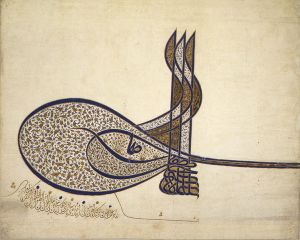
Tughra_Suleiman
Tughra of Suleiman the Magnificent

Yes, Arabic has an impressive set of tools. Here are a few:

It sets a meter with musical aspects. Each sound may extend in duration by holding a tone twice or three times as long. It’s really much like reading a piece of sheet music, a musical score.

It has tools for creating calligraphic expressions that allow each writer to break away — to proceed beyond a ceiling-line and below a floor-line. By comparison, Latin-based alphabets seem designed with confinement in mind, something designed with the chisel in mind. Keep within the lines, please. The Romans manipulated numbers borrowed from their alphabet. You can count to 100 in Roman numerals before encountering a curved figure.
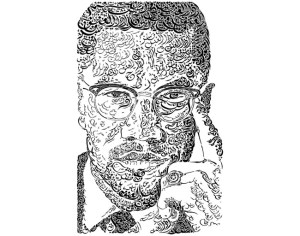
malcolm-x-arabic-calligraphy-centre
“Malcolm” by Everitte Gurney Barbee

Did you know that Arabic vocabulary is context sensitive? Language environments are dynamic places, words adapt to merge with the spirit and the moment and the intent — not the other way around. Translations that do not recognize context contort meaning, they must be challenged. Twisting words to serve agendas is a dark art.

The English language uses a different set of tools, different metrics that root into the soil of a different geography.
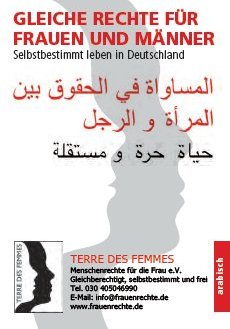
faltblatt-gleiche-rechte-arabisch
Equal Rights for Women and Men: Self-determined Life in Germany

Language has brought me opportunities to remove borders. A thorough understanding of the German language (my second language) permits me to learn Arabic from a teacher who has likewise learned German as her second language. There’s something breathtaking about acquiring a third language without the unnecessary baggage of my mother tongue. Something very humbling and very satisfying.

Thanks for reading.

Mistranslation as False Witness

Western Civilization celebrates roots that extend to the Eastern Mediterranean, a body of water once surrounded by the Roman Empire. When that empire imploded, the power vacuum filled the remnant structure with fresh blood. One such pulsing corpus was Christianity — one authored by a former Roman citizen: Saul before his metamorphosis. There is no compelling historical evidence to suggest that Peter coauthored with Paul in Rome. I agree with Jewish scholar Hyam Maccoby: The Mythmaker: Paul and the Invention of Christianity for the argument that Peter had traveled to the east as far as Baghdad, but he had never ventured west of Palestine. The Roman Catholic Church relies upon an apostolic rock, but she freely admits that its reality anchors on Tradition and the Magisterium — historical facts notwithstanding.

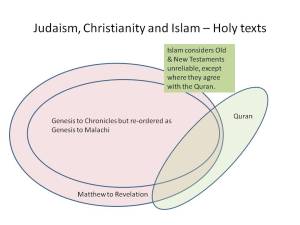
The Eastern Mediterranean coastline describes the shortest path between Africa and Eurasia. An incomparable piece of real estate, not what I would call a swamp, though some have: Unfortunately, It Was Paradise. Palestine is sacred soil for the three monotheistic faiths that declare solemn roots at that Eastern confluence, that Holy Land, that stomping grounds of patriarch Ibrahim. Although Ishmael was Ibrahim’s eldest son, he was also the “illegitimate” son of a slave girl known by Ishmael’s father. Isaac was the “legitimate” son of non-enslaved Sara. Islam recognizes Ishmael as the elder son of Ibrahim.

You can read about it in a Qur’an near you. In fact, you may find any number of interpretations freely available online. However, I recommend that you consider an interpretation carefully. My personal copy is a translation by Abdel Haleem: The Qur’an.

abdel.haleem

I attended an interfaith program that included a local well respected and knowledgeable Imam. A seething attendee slammed his personal copy of “The Holy Koran” onto the table. His question: “Do you know what this book says?” The Imam responded: “It depends upon the translation.” Would you accept a Bible translation that recounts the poisoning of the loaves, the tainting of the wine?

judaism.christianity.islam.venn

Radical Google® Searches
  1. “Radical Christian Terrorism” (About 9,310 results (0.66 seconds) )
  2. “Radical Islamic Terrorism” (About 231,000 results (0.43 seconds)
  3. “Radical Judaic Terrorism” (About 21 results (0.39 seconds)


Native Americans, African Americans, and Palestinians share something that Northern Europeans do not: a skin too red, too black or too olive (a characteristic of humans from the sun-rich climate.

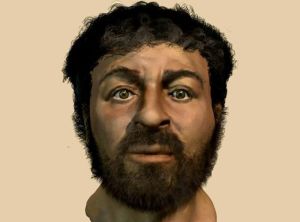
That’s an unforgivable crime if racism is your touchstone. Why are Biblical personalities depicted with impossibly Northern European features, such as blue eyes, fair skin, an athletic countenance? Who were the original authors of the Torah, the Bible, the Qur’an? Is that a loaded question? They were Semitic peoples who spoke Semitic languages.


jesus.computer.generated
Computer-generated depiction by BBC of the historic Jesus. Click image for details. 


Why does Islam honor Ishmael? What did he do to deserve exile? The Judeo-Christian tradition honors Isaac. What’s up with that? I’ll check that out and get back to you, I have to get to the dirty dishes first, they’re over there in the sink.

Nota bene: The wilder the spurious translation of the Qur’an, the wider is it circulated, the ever endless is it immortalized by false witnesses.

Making stuff up to stoke an agenda is dishonest. It weakens your credibility. Just saying.


 Thanks for reading.


Surprised by Sudden Sounds

Hello, what?

A firsthand account of a hearing challenge, one told in the first person. That’s what. Hello in there, hello.

Simone: I know you’re right, Pee-wee, but…

Pee-wee: But what? Everyone I know has a big “But…? C’mon, Simone, let’s talk about *your* big “But”.

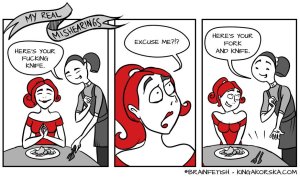
Before opting for a $400 pair of hearing aids, I asked some friends and relatives if they were happy with a pair of ear inserts, ones that had cost twice as much as the shiny new automobile I purchased in 1973 (an AMC Gremlin if you must know). Each wearer had a big but that for one reason or ‘tother, so I just kept on mishearing words — mis-heards that made me the butt of many an “Are you deaf?” joke. My sister-in-law works with the elderly, she recognized the dynamic, remarking that many who mishear are falsely diagnosed as suffering from “dementia”.fork.and.knife

Oliver Sacks, the sorely missed independent thinker,  wrote an opinion piece for the New York Times that captures his personal experience with hearing loss: “Mishearings.” A timely take on the mind’s capacity for assigning meaning to spoken language.

And yet there is often a sort of style or wit — a “dash ”— in these instantaneous inventions; they reflect, to some extent, one’s own interests and experiences, and I rather enjoy them. Only in the realm of mishearing — at least, my mishearings — can a biography of cancer become a biography of Cantor (one of my favorite mathematicians), tarot cards turn into pteropods, a grocery bag into a poetry bag, all-or-noneness into oral numbness, a porch into a Porsche, and a mere mention of Christmas Eve a command to “Kiss my feet!”


Hearing loss had removed many unfortunate sounds: the song of birds, the snores of Loki the Cat, the sussurance of the familiar, the soothing and the calming. However, at this very moment I am listening to the sharp, measured and deliberate crunches Loki is making — less than a meter away.


OLYMPUS DIGITAL CAMERA
Bird Sounds on DirtNKids 🙂


I am able to attend Arabic language classes at the local masjid once again, to actually understand the critical meanings lost to mishearings. It’s wonderful to join in with a measure of confidence that was quite impossible before 🙂

Now here is an unexpected but welcome circumstance: turning the devices off stills the din, the conical insert even acts as an earplug of sorts.

Now I jump into a wild cacophony of sound with a grateful soul. According to the instruction manual, it’s a gradual process that takes a bit of patience. I’ve only worn them for a week now, so my mind is still refreshing the inventory of sounds unheard for many years: floorboards squeak, a wall clock clicks with each passing second (I’ve timed it!) and my feet make a sweeping sound on a carpet.

Thanks for reading.


Surprised by Arabic

At its largest extent, the Roman Empire surrounded Middle Earth, literally “The Mediterranean.”

inscription_cartilia2


In the parlance of social media, the Romans SHOUTED all their written words — minuscules would not arrive to soften the literal commotion until the 7th Century. Latin seems suited for chiseling into stone, mostly with straight lines that run from left to right. It’s not easy to curve while chiseling your way along a flat rock-face. A glance at the English alphabet reveals that individual letters also run from left to right, letters such as B D E F K L P R

The letter “J” is quite the exception. It’s one reason that some school children do this:

printable-letter-backwards-j

That letter never appears in Roman imperial inscriptions, nor did U, nor did W.

K, Y and Z were adopted to accommodate Greek vocabulary. They are not the Etruscan uttering way. Nay, they ain’t.

Let’s look at a language that appeals to my left-handedness. It’s quite a relief to see my writing as I write. Arabic was not designed with a chisel in mind. The language begins with cursive in mind, not a bland sequence of letters imprisoned within imaginary boxes, then proclaimed “words.”

My last post looked at a procrustean camel, an animal led to the eye of a needle by dint of faulty translation. Why are mistranslations carved into stone? Do not allow your metaphors to become stilted, clunky, confusing and hackneyed. That’s what I say.

Well, Arabic comes equipped with a J-sound. In fact, it’s standard equipment. However, the language does not permit a “P” letter, so please apply a “B” for words like Paris: call it Baris and learn to live with it. Palestine never needed a “P” because that name is an imposition anyway: they are the Philistines. Arabic comes equipped with an “F” sound.


arabic.jim
25+ Arabic Alphabet Letters


Instead of imaginary boxes, Arabic allows for up to four ways to write each letter of the alphabet. Learners of this language and readers of the Qur’an receive the gift of ten diacritical marks to aid the learning process in a clean and coherent manner. Should you ever decide to tackle Arabic, this is handy indeed. Those marks reveal the sound one millimeter at a time; however, once you become comfortable and confident with the words you can dispense with diacriticals altogether — you’ll recognize the pattern and you won’t need the training wheels.

Returning to the Romans for a moment: would you ever wish to return to Roman numerals once you’ve learned the efficacy of Arabic numerals? The word “cipher” in English is from the Arabic word for “zero”:صفر

Here is a tip for my readers who consider learning German or Arabic: if you can pronounce Cincinnati you can pronounce  صفر (sifr). Just pedanting.

Learning languages removes artificial separations between cultures and lifestyles. Those separations take the form of borders, walls and prejudice. In their stead you acquire perspectives that remove each border, wall and prejudice. They serve the minions of geopolitical advantage and the clarion to endless war, endless confusion and endless imprisonment. Producing propaganda is criminal activity. Always. Whatever your intention.

And go vegan while you’re at it. No sentient being benefits by closing the book on the Anthropocene 🙂

Thanks for reading.