Alley Oop and Woogazoola

In search of the ineffable WOOGAZOOLA.

My youngest sister C. recently posed a question in an electronic forum. It addresses an etymology that continues to pique the interest of my oldest sister: T.

“My sister T. and I are trying to figure out what a “Woogazoola” is. Our mother used to say our hair looked like a “Woogazoola” when it was messed up. My understanding was that it was a comic strip character from maybe the 1920’s or 1930’s. Anyone have any idea?”

A response from H. followed in short order:

“My mom thinks it might have come from the comic strip Alley Oop from the thirty’s.”

hamlin_arizona-2

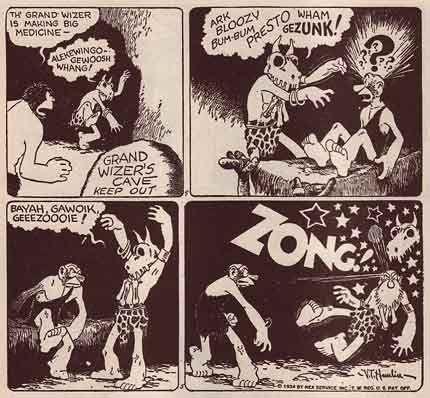
I think H.’s mom has hit a nail on the head. Let’s take some time to consider this clue. I have discovered an Alley Oop comic strip from sometime between 1932 and 1939. My mother would have been from 11 to 18 at that time, perhaps already remarking upon classmates’ messed hair. Here we see Alley Oop with The Grand Wizer:
alley.oop.wizer

A point to ponder: text contained within comic strip balloons is scarcely as googleable as:

===> this here text <===

Internet search engines do not parse the words in a balloon, so I decided to actually read some more Alley Oop comic strips from the 1930’s.

In the highly unlikely event that you are reading these words, I will point out that my findings are anecdotal at best. They are also probably incompetent, irrelevant and immaterial — I leave it to the judge to decide that.

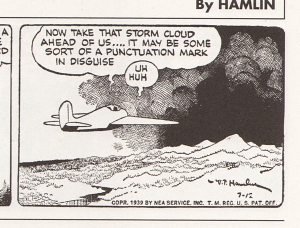
Well then, I shall now toss in a few presumptuous conjectures. These have been peer-reviewed by our cat Loki: my go-between editor (Loki is sitting in a cardboard box between the keyboard and the monitor).
oop.punctuation

Now, let us consider context. We already know that “messed up hair” elicited what I am tentatively calling an incantation: “Woogazoola.” Additional research is needed to find other contexts that would have elicited the motherly exclamation “Woogazoola.”

But let’s work with what we have: two words that beggar the imagination. Consider the 3rd frame. The Grand Wizer has a skull on his head, he incants: “GAWOIK GEEEZOOOIE !”

Hamlin has a way with ALL CAPS, bold fonts and the gradual change in font size. Witness GEZUNK! and ZONG!

Look for the consonants G K W and Z, for example. Then switch over to vowels that wow you with their repetition: OO, OOO. The name of Oop’s girlfriend? OOOLA.
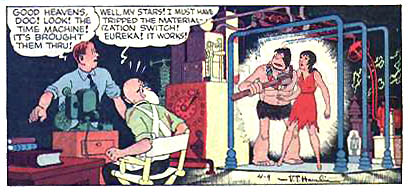
Ooptimemachine4939

Modern science fiction owes much to Hamlin’s vision. He set a model for time travel that is still familiar stuff. Take a look at The Precisely Rendered Blam to whet your interest 🙂

Woogazoola!

Thanks for reading.


The Case of the Missing Article

The Case of the Missing Article by E. Stanley, the Gardener.

“In the days before the arrival of the cicadas, the frogs and the dreadnoughts, in the land of the dead, the gardener tended the garden green. Suddenly a shot rang out.”

The” is definite English, it’s been that way since the Vikings killed the sixteen ways the Saxons (Sachsen) spoke, ways always to denote nouns. A part of speech now dead in the Isles of the Brit, many eons afore days of present kind.

To the victor goes the grammar. “THE” spake the Viking, and it was so.

Word order reigns where inflection governs. Do away with inflection and you become a slave to word order. By good fortune I suffered the arrows and the slings of Latin in high school. An introduction to case-driven tongues, that’s what it was.

scribblers.sculptors.scribes
Wheelock’s Latin

I’ve since revived my high-school understanding of Latin via (a Latin preposition you understand) the Wheelock method. I think that it’s fun to discover unexpected similarities between German and Latin, ones that originated in Indo-European. The preposition “in” uses the same cases (dative and accusative) to denote intra and inter movement, respectively. Now that is what I call a good time. A grand substitute for the dreadnought of sports`. In very fact, I am extraordinarily ignorant of any iota embalmed as sport.

indo.european.migrations

I like to bounce around among crowds of languages, to weigh their lot for commonalities, patterns and purposes.

No writings remain of Indo-European, the common root tongue for hundreds of languages. A tongue spoken in a geography we now call Ukraine and vicinity.

The English word “scribe” finds origin in the German schreiben.

Schreiben — writing.

Scribe – writer, transcription, scrivener (of Bartleby fame).

bartleby

When teaching German I would often encounter worthy mnemonics to aid student learning. Once, while writing the German verb “beschreiben” on the blackboard I noticed that its English equivalent “to describe” possessed an unexpected aspect: pivot the round part around the vertical part of the letter “b”, the letter “d.”

b d b d

beschreiben/describe

rotate the “b” to fashion a “d”, rotate a “d” to fashion a “b.”

be de are inseparable prefixes that lend flavor and spice to a foundational word, such as schreiben or scribe. It’s also great fun to encounter such things — the stuff of useful heuristics.

Thanks for reading.


Die schreckliche Englische Sprache

N.B. I have not yet inserted a translation plug-in.

Why not, Bill?

I don’t want to crash this blog by pasting html code improperly.

Kommen wir gleich zur Sache — die Wikinger emigrierten von Sachsen nach England im Jahre 793, und sie hatten mit den eroberten Frauen und den zukünftigen Kindern sprechen wollen. Hör mal zu: die Wikinger konnten die ungeheueren komplizierten Endungen jedes Dingworts überhaupt nicht verstehen. Die Eroberer hatten eine Lösung schnell gefunden: zum Teufel mit den verdammten Endungen.

This is a thinly veiled attack upon the official language of the free world. What be your purpose here?

WikingerServiette

Wenn Sie English lesen können, schauen Sie den folgenden Link an:

How Vikings Changed the English Language: Morphology.

Interessanterweise fing die große Vokalverschiebung zur etwa gleichen Zeit an. So viel wurden dabei geändert, aber so passieren die alternativen Geschichten.

als ob

Stellen Sie mal vor: “als ob” habe ich in einem Glossar der literarischen Ausdrücken gefunden, zwar als eine Übersetzung des Konzepts von Samuel Colleridge:

the willing suspension of disbelief 

5 Buchstaben auf Deutsch gegen 31 auf Englisch. Finde ich den Unterschied super. Eine Sprache zu lernen ist ein Abenteuer anzufangen, meiner Meinung nach.

denken.sie.doch.selber
Bill, why did you choose a SHOUTING green font to threaten world order? We’re taking names.

Gern behaupte ich, dass man einen deutschen Text schneller als einen englischen Text lesen kann. Einfach erkläre ich den Urgrund dieser Behauptung — Schon beim ersten Wort erkennen wir die Funktion des ersten Wortes, z.B. “dem” muss unbedingt das indirekte Object signalisieren. Also, entweder Maskulin oder Neutrum, oder?

Quod erat demonstrandum.

So wurde “the” erfunden. Wortstellung muss jede Funktion, bzw. jeden Kasus erklären. Konnten Herr Wiking mit der Familie anreden.

Ich hoffe, dass die Leser dieses Dingsbums mein Thema genossen haben.


…don’t say anything at all

Bill, you have crafted the perfect post title. Please take you own advice — say nothing…at all


Nice and Kind

Random acts of niceness?

One of first posts I wrote for this blog is Nice People Explained — 22 months ago. It’s about a philosopher who is tut-tutted in many circles: Bertrand Russell. That particular essay introduced me to the very concept of what it means to be nice in polite society — a form of expedience that keeps the wheels of industry churning and chugging, becoming accustomed to certain niceties. Leo Tolstoy was ahead of his time and ours.

Leo-Tolstoy-Quotes-27-I-Sit-On-A-Mans-Back-Choking-Him-And-...-Quotes-768x756

Yesterday I read great stuff on a great  blog that I recommend to you. May I direct your attention to the eponymous ShelbyCourtland. Great and timely stuff there IMO. Coincidentally, some people would not think Shelby very nice. Speaking up for the exploited doesn’t get the job done. Well, that’s nice, BUT.

Well, there’s a wide chasm between nice and  kind. Kurt Vonnegut did not say be nice, the word Kurt chose was “kind.” Many do not consider him a very nice person either. I once met an unkind person who had met Vonnegut once, and reported that he was not very nice.

You are wasting your time, my friend. By the way, have you ever heard the one about the nice nun who, let’s say ‘got the job done’ in certain elementary school classrooms of the 1950’s?

By “getting the job done” I think you mean training classroom bullies on the nicer points of humiliation? Yes. Thought very nice, very nice indeed.

nuns.with.rulers

Here’s my hypothesis: Nice people conform to the expectations imposed by authority to perpetuate the way it’s always been done and the ways that always work. They never rock boats or speak out of line. They don’t laugh at crap hounds like Jeff Sessions, lest they be likewise incarcerated. There’s nothing remotely fascist about that, is there?  Boats are not for rocking — unless the boats are carrying refugees from profitable wars initiated by the nicest country on Earth. Endless war to stop all those wars that end inconveniently: for armament suppliers. Endless slaughter of fellow sentient beings in technologically advanced death camps — it’s what’s for dinner.

Perform random acts of kindness when they are totally unexpected. Do them often. Do them creatively, even playfully. Get off someone’s back?

Smart and Pleasant

I’m asking Elwood P. Dowd to take over here while I visit the restroom. Please be kind to Mr. Dowd, who knows both smart and pleasant:

“Years ago my mother used to say to me, she’d say, “In this world, Elwood, you must be” – she always called me Elwood – “In this world, Elwood, you must be oh so smart or oh so pleasant.” Well, for years I was smart. I recommend pleasant. You may quote me.”

Here is a clip from the 1950 version starring Jimmy Stewart featuring the snippet above.

elwood.p.dowd

My mother, in addition to always calling me Billy, used to say to me “If you don’t have anythingnice to say…”

Or was it “…good to say?” Well let’s find out what good old Google reports on good and nice:

  1. Hits for nice: About 793,000 results (0.93 seconds)
  2. Hits for good: About 220,000 results (0.46 seconds) 
OK, let’s divide 793 by 220 and see if we obtain a result. Right.
Nice Defeats Good
Rather dour fare for a Saturday morning, don’t you know? Your really should have followed through with “… don’t say anything at all.  
Quite right, time for something restful and delightful, in full measure 🙂
The best place I know for taking a breather is upon a sentient cloud. Let’s jump in for a worthy discussion on the proper use of the ellipsis, to whit one written by Esme.

I understand that the shortest distance between two dots is another dot. So let us lose ourselves  in aethereal clouds; particularly after sloughing through this dour post.

Hey, did you know that fog is a cloud resting on the ground? We live just south of Cincinnati, I once saw the tallest building in town pointing out above a wonderful white cloud one morning while driving to where ever the heck I was working at that time.

Thanks for reading.