Please Don’t Slam Islam

Lisa and I celebrate 25 years together this very year, remarkable marks we have made together: 7 years in the 20th Century and 16 years into the 21st Century. So, two millennia and counting 🙂

We met online at the speed of a dial-up: 1200 baud via a Unix powered bulletin boarding system called TriState Online, a public service of the local phone company. One anniversary I printed a long set of conversations and placed the matrix-dotted leaves  in a binder — it’s in yonder armoire.

1200.baud

The sound of a dial-up

Human shadows grow long and weary over time. Consider this, consider this: Ibrahim the Patriarch and his family. Lisa knows more about that soap opera than do I, and she knows her sources. She is well versed in Biblical affairs involving affairs, being one who believes the actual teachings of Jesus, something long lost in trampling, trampings and rumors of war) lost or defiled in the translation. Once you die there is no telling how your follows will bend, fold and mutilate the spoken word become Word.

Lisa:

I am always moved by my husband’s compassion for the “underdog.” I know the Palestinians have religious customs we may find archaic. I had a close friend whose belief was performed daily with 5 prayers from the 5 aspects surrounding her, the knowledge that God’s eyes were on her always.

Allow me to quote a descriptive text from the pen of John Walton, a soul seeking balance rather than judgement, understanding rather than divisiveness.

John Walton:

…please be patient and take the time to read — realizing that as Christians we share in the same salvation offered to the Arabic people whose religion grew up around that God — with their own Prophet to guide them in the dogma — the same as as with Pauline doctrine… Later, Hagar bore a son to Abram and named him Ishmael, as the Lord had told her to (Genesis 16:15). Hagar’s story resumes fourteen years later when Isaac was born to Abraham and Sarah (Genesis 21). Shortly after Isaac was weaned, Sarah saw Ishmael taunting him and took the matter to Abraham: “Get rid of that slave woman and her son, for that woman’s son will never share in the inheritance with my son Isaac” (Genesis 21:10). Although it grieved Abraham to do so, he gave Hagar and Ishmael some provisions and sent them away, and Ishmael and his mother wandered in the desert (verse 14).

When Hagar’s food and water ran out, she did not know what to do. She put Ishmael under a bush for shade and then went a few paces away so she would not have to watch him die (Genesis 21:16). As Hagar wept, the Lord called to her from heaven with words of comfort (verse 17); God then gave her a promise: “Lift the boy up and take him by the hand, for I will make him into a great nation” (verse 18). The Bible says that God “opened her eyes and she saw a well of water” that she had not seen in her distress (verse 19). God rescued Hagar and gave her hope and direction. God was with Ishmael as he grew up in the desert (verse 20).

BethlehemChristmasSmall

Abraham’s sin with Hagar has resulted in centuries of sorrow and bloodshed, as the descendants of Isaac (the Jews) and Ishmael (the Arabs) have been mortal enemies since Bible days. Mohammed, the father of Islam, is said to have been from the line of Ishmael, which is one reason Muslims claim a right to the Promised Land, Israel. Hagar is a revered woman in Islam since Ishmael is the father of the Arabic people. The Qur’anic version of the Genesis account twists the story to make Hagar the heroine of the story and her son, Ishmael, the child of promise instead of Isaac.alhamdulillah

The apostle Paul uses the story of Hagar and Sarah to teach a spiritual truth concerning our salvation. In Galatians 4, Hagar represents the Old Covenant, based on the Law (given at Sinai in Arabia) and human works. Sarah represents the New Covenant, based on grace and the saving work of God. In Paul’s analogy, believers in Christ are like the child born of Sarah—we are free, products of the Spirit. Those who try to earn their salvation by their own works are like the child born of Hagar—they are slaves, products of the flesh. “Therefore, brothers and sisters, we are not children of the slave woman, but of the free woman” (Galatians 4:31). Paul counsels believers to “get rid of the slave woman” (verse 30)—that is, cease trying to earn salvation, because the inheritance of the children of promise can never be shared with those who live under the dictates of the flesh.

The story of Hagar is full of God’s goodness, and we can learn from the way God worked in Hagar’s life. She was a nobody, a foreign slave girl. Yet the Lord of Heaven saw her in her distress, provided for her need, and blessed her son because he was the child of Abraham. Hagar gave us the term El Roi, which means “the God who sees.” And her story reminds us that, no matter who we are or where we are, the Lord God sees us.

mashallah


Thank you for reading and I hope the desperation of a people being forced into a ghetto, with dwindling resources and constant raids by military police may remind you of something the current Israeli government seems unable to recognize as the same forest they survived — for its blind focus on the trees. God bless all of us and may we share the security and peace we enjoy with those less fortunate, at home and abroad.

alhamdulillah.meme

Whisper Alhamdulillah softly and reverently in an aircraft, or suffer slings and arrows. Speaking at a conversational volume and you may find yourself immediately and roughly removed from the company of some very nice people. Very nice indeed.

“Is Islam a religion of peace?”  91,400 results (0.36 seconds)
“Is Christianity a religion of peace?” 5,970 results (0.44 seconds)
“The Rosary is an assault weapon with a 50 round clip.” Philosopher Dave.

Thanks for reading.

Die schreckliche Englische Sprache

N.B. I have not yet inserted a translation plug-in.

Why not, Bill?

I don’t want to crash this blog by pasting html code improperly.

Kommen wir gleich zur Sache — die Wikinger emigrierten von Sachsen nach England im Jahre 793, und sie hatten mit den eroberten Frauen und den zukünftigen Kindern sprechen wollen. Hör mal zu: die Wikinger konnten die ungeheueren komplizierten Endungen jedes Dingworts überhaupt nicht verstehen. Die Eroberer hatten eine Lösung schnell gefunden: zum Teufel mit den verdammten Endungen.

This is a thinly veiled attack upon the official language of the free world. What be your purpose here?

WikingerServiette

Wenn Sie English lesen kĂśnnen, schauen Sie den folgenden Link an:

How Vikings Changed the English Language: Morphology.

Interessanterweise fing die große Vokalverschiebung zur etwa gleichen Zeit an. So viel wurden dabei geändert, aber so passieren die alternativen Geschichten.

als ob

Stellen Sie mal vor: “als ob” habe ich in einem Glossar der literarischen AusdrĂźcken gefunden, zwar als eine Übersetzung des Konzepts von Samuel Colleridge:

the willing suspension of disbelief 

5 Buchstaben auf Deutsch gegen 31 auf Englisch. Finde ich den Unterschied super. Eine Sprache zu lernen ist ein Abenteuer anzufangen, meiner Meinung nach.

denken.sie.doch.selber
Bill, why did you choose a SHOUTING green font to threaten world order? We’re taking names.

Gern behaupte ich, dass man einen deutschen Text schneller als einen englischen Text lesen kann. Einfach erkläre ich den Urgrund dieser Behauptung — Schon beim ersten Wort erkennen wir die Funktion des ersten Wortes, z.B. “dem” muss unbedingt das indirekte Object signalisieren. Also, entweder Maskulin oder Neutrum, oder?

Quod erat demonstrandum.

So wurde “the” erfunden. Wortstellung muss jede Funktion, bzw. jeden Kasus erklären. Konnten Herr Wiking mit der Familie anreden.

Ich hoffe, dass die Leser dieses Dingsbums mein Thema genossen haben.


LEGO, AUDIO, VIDEO: I Read, I Hear, I See

As April 30 yielded to May 1, I recalled that Old-Time Radio will have passed the wand over to New-Time Television exactly 55 years ago this coming September 30; in fact, the final two shows turned their microphones off on the same day.

JD_Button

In the unlikely event that you have already guessed which two programs made it curtains for that classic era, I roll the timpani — or cue the crickets.

Und so:

  1. Suspense
  2. Yours Truly, Johnny Dollar

Three suggestions for those new to the realm — a land wide, deep and satisfying.

  1. Vic and Sade
  2. Pat Novak for Hire
  3. Inner Sanctum
Vic-And-Sade-mp3
Paul Rhymer was the genius behind Vic and Sade

I have a soft spot in my heart for programs that settle into my psyche by way of sound waves — words existing on the printed page give your mind the means to fashion words to worlds. To use my sagacious father’s favorite phrase

“Well, let’s put it this way” — I prefer lego (I read) and audio (I hear) to video (I see). Reader or listener rather than viewer, what gives? Reading and listening demand more of the imagination. Theater of the Mind. Not my coined phrase, but dramatically accurate.


vacuum.tube.radio.deviant.art

Personally, viewing alone is like drinking alone — the experience doesn’t end well. It might work splendidly for thee, but not for me. In other words, judging my readers is never my aim (file under marginalia).

On with the show.

Watching TV with others involves participation. Joel Hodgson is the genius behind MST 3000 — an absolutely brilliant concept that sets Hodgson’s haplessly condemned yet innocent victim off planet, and forced to watch amazingly bad movies, a torture you may have experienced personally. Joel and his Bots (his own creation by the way) breaks that fourth wall too, perhaps a fifth wall.

Full disclosure: Lisa would rather shout VIDEO, ERGO SUM to my AUDIO, ERGO SUM. Well, let’s put it this way: we complement each other. So there!

video-ergo-sum-680x400
I view, therefor I am

During my years in West Germany (1971 to 1973), watching television was only good for language learning. Here is a recommendation for the next time you surf 255 channels — set subtitles to another language. Better still: watch a foreign film and set the subtitles to a language you want to learn. Experiencing a world without English language is a rare delight. I recommend it most heartily.  🙂

Advertisers want to make you think that the volition is entirely yours. IMO (only?), we do not live in the best of all possible worlds. Though you might be surprised to read that veganism is an effective remedy for that  imposition of schizophrenia upon readers, listeners and viewers. Blood-toothed marketers wish to either introduce or reinforce product loyalty. FTS say I. Out damned blood! FWIW, I pay an annual fee to keep this site advertising-free.

Addendum: I didn’t know that FTS was a sports term, so I pass that torch to my sports broadcasting alter ego. It was intended as a term of frustration directed at frustrating the darker side of advertising. Channel to ESPN-42 for more 🙂

Thanks for reading.


Discovering Patterns in Language

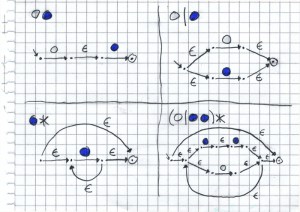
Regular expressions. are powerful metamathematical tools, advanced techniques for matching patterns in a text or multiple texts — something fun and something useful. They are concise chunks of cryptic characters that can search a single text or multiple texts for precise patterns. Select an input file, do one thing or very many things to the file, then drop the resulting text into an output file.

regex-to-fa

Stephen Cole Kleene is the mathematician and philosopher who introduced the concept of the regular expression. He worked with Alan Turing and other pioneering types who were intensely active in the 1930’s. Their understanding of a mathematical maneuver called recursion; that led to breakthrough tools in logic — decisions made at superhuman speed and using the processing speed and memory to process words and numbers thrown together and called data. However, beware of the sorcerer’s apprentice phenomenon. Just bewaring.

recursion

An example: look for successive occurrences of WTF (upper or lower case) and substitute “what the fart”.

Through recursion you can stop, go backward a certain of characters, query the findings. Do something with it. Once you become familiar with the meta characters and the syntax, you can do a lot of useful things or destroy many useful things. So save the original file in a safe place and know where your output file ends up.


When I was a freelance translator I maintained a translation memory database that kept track of all my translations so that I might be reminded of earlier translations. The software I used was called SDL Trados; however, that was over ten years ago.

Here is one example of how I used regular expression code to insert a carriage return and linefeed whenever a blank space appeared in the original German. Essentially this created records that were one word long — the number of records was the number of words in the text. Then I queried my database for finds. A lot faster than the technique I used when learning German — looking up the words in a large-ass dictionary that I still have on the bottom shelf over there.

mastering.regular.expressions

The same Unix tools developed in the 1960’s remain in the electrons flowing from my screen to yours. They remind me of Arthur C. Clarke’s three laws:

  1. When a distinguished but elderly scientist states that something is possible, he is almost certainly right. When he states that something is impossible, he is very probably wrong.
  2. The only way of discovering the limits of the possible is to venture a little way past them into the impossible.
  3. Any sufficiently advanced technology is indistinguishable from magic.

— Arthur C. Clarke’s Three Laws

Hoping this is somewhat illuminating, or mildly amusing 🙂

Thanks for reading.

P.S. Now for something incompletely different, something inspired by Hariod Brawn’s comment below. It’s an article on The Sound (And Taste) Of Music by Layla Eplett — she brings a platter to the conversation and complements Mariano Sigman’s TED Talk:


SoundTasteofMusic
Layla Eplett

Thanks for reading this postscript 🙂