“Those who know Arabic are jinn among humans, they can see what nobody else can. Imam Shafii
“Again I tell you, it is easier for a camel to go through the eye of a needle than for someone who is rich to enter the kingdom of God.”
— Matthew 19:24 (NIV)
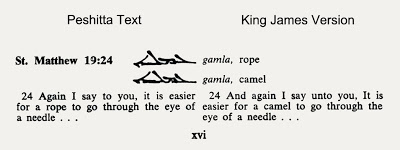
You know this Bible quote. I am certain you’ve seen it countless times. It might be your favorite chapter and verse. But why a camel? Well, ‘camel’ is a misnomer — a mistranslation immortal. The intended object was ‘rope’, specifically a thick twisted rope: a hawser.
Which is the more eloquent simile:
it is easier for a camel to go through the eye of a needle…
it is easier to thread a hawser through the eye of a needle…
Why is this obviousity never mentioned?
The Bible Hub, an online resource for Bible scholars, provides English language variants for every chapter and verse, among them Matthew 19:24. Click that link to compare 28 translations regarding a rich guy’s odds of entering the Kingdom of God.
Mistranslations are the coin of many a realm, perhaps this one most appropriately so. I am hardly the first to learn, two millennia after the coin was struck, that the writer intended something comparable to a thread.
What is the camel doing in the sewing kit with the needles and threads anyway? The original metaphor roots in Aramaic language, one of the Semitic languages that use consonantal roots to convey meaning:
An alternative scripture, The Qur’an, provides just such a footnote. Here is one from the well-respected translator M.A.S. Abdel Haleem:
The gates of Heaven will not be open to those who rejected Our revelations and arrogantly spurned them; even if a thick rope a were to pass through the eye of a needle they would not enter the Garden.
— Quran “The Garden” 7:40 M.A.S. Abdel Haleem translation 2004
Haleem inserts this footnote for 7:40:
Not ‘camel’. The roots of the words for ‘camel’ and ‘thick twisted rope’ are the same in Arabic and ‘rope’ makes more sense here (Razi).
You may get PTSD, but learning German is a good way to learn the grammar you forgot — or the grammar you never learned. German is as fulsome as it is fulsome in that respect, something like a built-in sentence diagram.
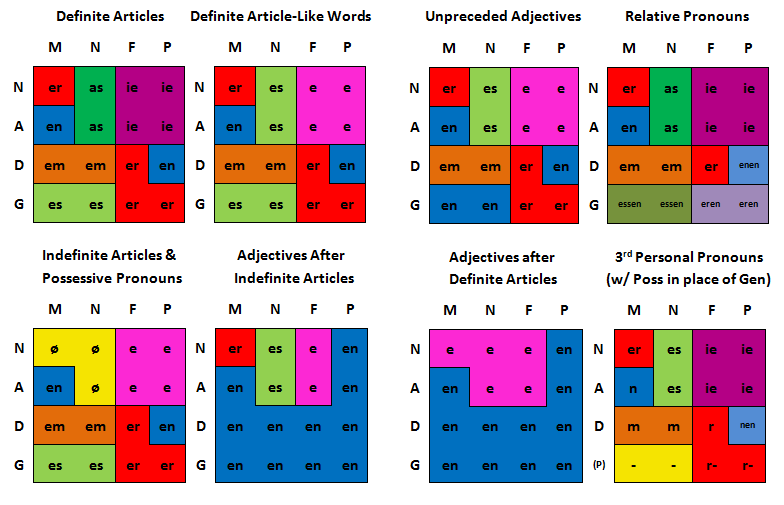
There are 16 ways to say “the” in German. Just as there are 16 ways to say “the” in English?
No. Each of the 16 ways in German tell you the gender, number and case of the following noun. So just IN CASE…
Having taught the language for decades I’ve found some tricks for avoiding German’s paradigms from hell, that’s what they are — and no mistake. Something they don’t tell you about until it’s too late to drop the class, I am hoping that this post serves as warning. It may be too late for me, but not for thee.
I found this “visual aid” at the following site. It’s a genuine P-O-S in my humblest opinion — ein Stück Scheisse.
Take a look at the über busy “visual aid” to the right. It’s a genuine P-O-S in my humblest opinion — ein Stück Scheisse, ohne Zweifel.
Mark Twain learned German (Fraktur even!) and lived to warn his readers: The Awful German Language. Fraktur inventors even thought of making the letter ‘f’ nearly indistinguishable from the letter ‘s’. So that you have to recognize the damned words containing ‘f’ and ‘s’ before you can understand what you are reading? Yes.
Consider the first line that the crow below is about to peck. “This is the Leipzig Fraktur font”:
I didn’t begin learning German until becoming an adult, when I needed it to study in West Germany in 1971. Sheer good fortune found me rooming with the only German student in the building who did not speak English…
Okay, enough of that, enough of that. What’s this lesson plan you wish to share?
Before the Vikings invaded Britain, English was still inflected the Saxon (Sachsen) way. The German “chs” became the simplified “x”. They had a land to plunder, so they took the gordian option — replace all the sixteen shades of inflection for the so-called “strong endings”” from der, die, das, den, dem and des to “the” and replace all the twelve shades of inflection for the so-called weak endings” to “the” as well. Knot cut.
German inflections do not flourish in non-German soil well. Norway, Sweden, Denmark, Netherlands — all of them pretty much did away with the meaning-by-inflection technique and applied the Viking way. Similarly, the Romance languages discarded the five declensions of Latin.
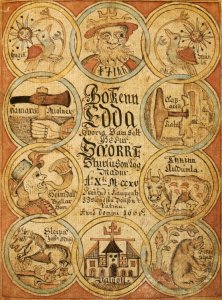
The only country that retained German (Nordic Branch) was Iceland. It has maintained all four cases and three genders for a millenium. Icelandic speakers can, with a bit of effort, read the Eddas. By the way, the Icelandic word for Iceland is Island — Iceland is land, is it not?
Now then, how do those inflections work in German language? I’m calling the following lesson plan The Case of the “The” by Erle Stanley Gaertner:
Über den Fluss und durch den Wald,
Zu Großvaters Haus gehen wir;
Die Pferde kennen den Weg, den Schlitten zu tragen
trotz des dreckigen und tiefen Schnees.
gegen den Regen und durch den Wald,
zur Grossmutter und zum Grossvater gehen wir!
Over [object of a preposition of relative position, accusative, masculine] river and through [preposition exclusively accusative, masculine, plural] wood,
To Grandfather’s house we go;
[subject, nominative, neuter, plural] horses know the way [direct object, accusative, masculine, plural] to carry [direct object, accusative, masculine, singular] sleigh
Despite [object of a preposition governed by genitive, masculine, singular]white and drifted snow.
Against [object of a preposition of relative position, accusative, masculine, singular] rain and through[object of a preposition governed by accusative, masculine, singular] wood,
to [preposition andobject of a preposition governed by dative, feminine, singular] grandmother and to [preposition and object of a preposition governed by dative, masculine, singular] grandfather we go!
Thank you Mr. Oogle, but those results are more helpful. Your bots do fine fast work.
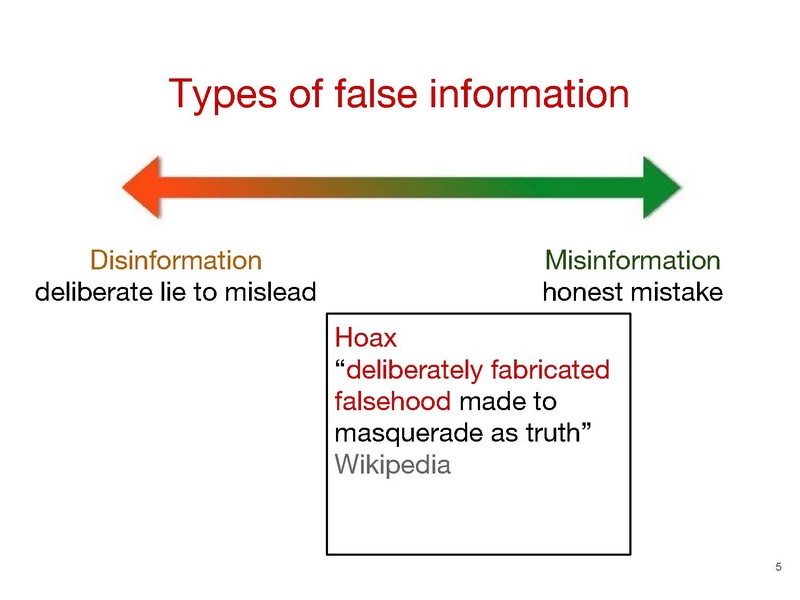
Memetics is a term invented by Richard Dawkins (1976: The Selfish Gene) to describe how information propagates in a network. The internet permits you to inform and misinform as rapidly as web-crawling bots can jump from here to anywhere.
A borg in Macedonia, a bot in Minnesota or a Shakespeare-typing monkey may be squinting at a computer screen as you read this.
Mr. G.O. Ogle, what’s a “meme generator”?
About 1,270,000 results (0.53 seconds)
Why an all-caps serif-free dishwater-grey font? Personally, I would prefer Henry Ford black.
Why would Gandhi quote Martin Luther King on Einstein’s memories of Logan Paul?
One of my star editors, Loki the Tortie, favors a workstation with instant access to the keyboard and the monitor. Please note that this strategic location also includes a cardboard box of suitable size and, as cat fanatics know well, an empty box is filled with a cat in the earliest possible nanosecond. She puts in long hours, so a workplace with good ergonomics contributes to overall productivity.
The coincidence of the alpha characters LOKI suggests that a trickster may also be at work here 🙂
Loki possesses some skills that make her work remarkable:
The ability to patiently ponder interwoven nexi of data trails, this requires deep concentration.
A studied demeanor of sustained mindful concentration.
A profound autonomic snore and schnark.
Sustained purring: a low vibratory murmur punctuated with sudden twitches of inexplicable insight.
I have recorded the intervals of Loki’s breathing/purring, using a set of statistical measures: each calculated, graphed and annotated in apocryphal lab notebooks in a carrel deep within the bowels of a hypothetical library at an unknown university, one where my research is not conducted.
Loki the Tortie in a familiar research station
Let us now proceed to Loki’s most recent research. Least, but for from first, Loki issues discrete keystrokes — typically in the range of 0.75 to 0.85 seconds with a stroke of a paw or claw trail.
Here is a link to some signature work recently keyed in 0.732 seconds:
A cursory glance suggests that Loki needed to urinate: 2p. The semicolons may be delimiters, some code or an urgency to cover the distance to the litter box — perhaps indicating 3 sets of paws (3×2=6 semicolons). In this vein, it is interesting to speculate on that missing “i” from an expected “loki”. Clearly, more research is needed.
These eleven (11) characters are as compact as any regular expression I’ve ever seen, they recall the intense memory restrictions of mid 20th Century computers such as Eniac. Coding in those days placed enormous restraints on code size at the machine level, so rapid nimble paw and claw strokes are a tribute to Loki’s computational genius and the elegance of her code.
Right now Loki the Tortie is in the middle of a mind meld with a couch cushion. I eagerly await the results of that meld 🙂
Meanwhile I want to read up on the work of Marc-Antoine Fardin, winner of the Ig® Nobel Prizefor 2017:
PHYSICS PRIZE [FRANCE, SINGAPORE, USA] — Marc-Antoine Fardin, for using fluid dynamics to probe the question “Can a Cat Be Both a Solid and a Liquid?”





 billziegler1947