Positive Discourse Analysis

Mira is the author of Everything socio and eco linguistic. In celebration of  the March for Science: Earth Day 2017, I yield the podium to my favorite socio and eco linguist — is there a better way to spend the day than to join me in this audience? No. In all events, allow me to present this esteemed socio-linguini a plaque fashioned from 100% recycled and recyclable electrons. It is an official prize: one bestowed on Mira for inspiring me to write an article on the work of Stephen Keene, Alan Turing and, while we’re at it, George Boole.

Here are the bases for blog-award bestowal:

The candidate must be —

  1. Enthusiastic
  2. Wise
  3. Inspiring
  4. Scholarly
  5. Intellectually curious
  6. Socio-eco-linguistically oriented
  7. Raises her voice for exploitable (and therefore exploited) sentient beings
  8. Writes about text analyses
  9. Appreciates vegan humor

On the other hand, here is a Descartes-Like phrase that does not describe the candidate for blog-award bestowal::

I exploit, therefore I am.

Meine Damen und Herren, darf ich vorstellen?


sociolinguini's avatarSociolinguini Blog

‘Discourse is shaped by relations of power, and invested with ideologies’.

 (Fairclough 1992: 8 in Jaworski and Coupland 1999: 2).

Critical Linguistics: a consciousness-raising tool

According to Tom Bartlett (2010), in the 70s and 80s the study of texts took a political turn in the UK, with the rise of Critical Linguistics (CL) (Kress and Hodge, 1979). The main aim of CL was to reveal how texts can hide or distort important aspects of the events they claim to represent. Analysis focused on grammatical features as well as vocabulary choices. A central aim was to unpackage biases and points of view that were concealed in publications such as newspapers, articles and school books.

One aspect of analysis that is still discussed today is that of agency, the way in which grammar allocates responsibility to participants. Here is an example from Kieran O’Halloran (2003):

  1. Policeshot 10 people today as violence…

View original post 967 more words
Discovering Patterns in Language

Regular expressions. are powerful metamathematical tools, advanced techniques for matching patterns in a text or multiple texts — something fun and something useful. They are concise chunks of cryptic characters that can search a single text or multiple texts for precise patterns. Select an input file, do one thing or very many things to the file, then drop the resulting text into an output file.

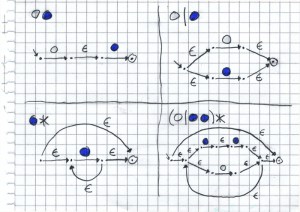
regex-to-fa

Stephen Cole Kleene is the mathematician and philosopher who introduced the concept of the regular expression. He worked with Alan Turing and other pioneering types who were intensely active in the 1930’s. Their understanding of a mathematical maneuver called recursion; that led to breakthrough tools in logic — decisions made at superhuman speed and using the processing speed and memory to process words and numbers thrown together and called data. However, beware of the sorcerer’s apprentice phenomenon. Just bewaring.

recursion

An example: look for successive occurrences of WTF (upper or lower case) and substitute “what the fart”.

Through recursion you can stop, go backward a certain of characters, query the findings. Do something with it. Once you become familiar with the meta characters and the syntax, you can do a lot of useful things or destroy many useful things. So save the original file in a safe place and know where your output file ends up.


When I was a freelance translator I maintained a translation memory database that kept track of all my translations so that I might be reminded of earlier translations. The software I used was called SDL Trados; however, that was over ten years ago.

Here is one example of how I used regular expression code to insert a carriage return and linefeed whenever a blank space appeared in the original German. Essentially this created records that were one word long — the number of records was the number of words in the text. Then I queried my database for finds. A lot faster than the technique I used when learning German — looking up the words in a large-ass dictionary that I still have on the bottom shelf over there.

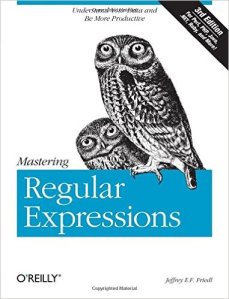
mastering.regular.expressions

The same Unix tools developed in the 1960’s remain in the electrons flowing from my screen to yours. They remind me of Arthur C. Clarke’s three laws:

  1. When a distinguished but elderly scientist states that something is possible, he is almost certainly right. When he states that something is impossible, he is very probably wrong.
  2. The only way of discovering the limits of the possible is to venture a little way past them into the impossible.
  3. Any sufficiently advanced technology is indistinguishable from magic.

Arthur C. Clarke’s Three Laws

Hoping this is somewhat illuminating, or mildly amusing 🙂

Thanks for reading.

P.S. Now for something incompletely different, something inspired by Hariod Brawn’s comment below. It’s an article on The Sound (And Taste) Of Music by Layla Eplett — she brings a platter to the conversation and complements Mariano Sigman’s TED Talk:


SoundTasteofMusic
Layla Eplett

Thanks for reading this postscript 🙂

Working on Computers in 1975

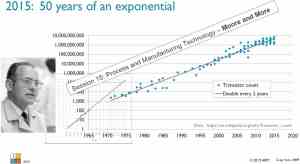
Let’s flip the toggle switch on my steampunked time machine and head back to 1975 — the year Gordon Moore revised his hypothesis on the potential exponential growth of computing power, now known as Moore’s Law: computing power doubles every two years. He surprised himself at its curious accuracy.

moore.graph
Semi.Wiki (a semiconductor’s discussion site

Let’s go back to 1975, a year when Singer built business computers — I worked on a Singer System 10. That sewing-machine outfit made a foray into small business systems, a foray that ended abruptly in 1976.


singer.computer
A fine two-tone-dial phone with rotary dial.

Ten years later I was assigned the task of converting a completely manual order processing system at a Cincinnati Milacron division in Blanchester, Ohio. They obtained a small business computer, a wardrobe-sized unit called a CIP 2200B, from the Milacron Products Division. So it was a hand-me-down — with 64K core memory, 10 megabyte fixed disc, 10 megabyte removable disc and a 96 column card reader/punch.

I reported to the corporate boss of information: Pat Goggins. She was a wonderful iconoclast who ruffled many corporate functionaries. I have a soft spot in my soul for independent minds because they threaten the order of things. That is as it should be. Vegans pose a threat to the tyranny of the majority, and that is a very good thing.

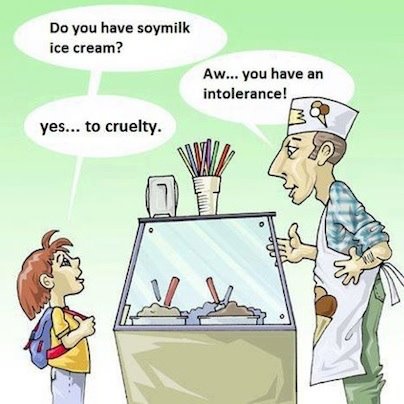
vegan.humor

The Electronic Circuit Materials Division manufactured board bases for Ford automobiles, crappy scrap for Radio Shack and all manner of integrated circuit users. It was a fascinating place to work in the 1980’s At that time I was a single parent to my two children — my wife Jeanne died in 1983, and I wouldn’t meet Lisa until 1993. so I chucked my suit-and-tie collection into the closet and returned to German language and literatures, a world I had left in 1973. We moved closer to town in 1987. It was a hot and densely humid day. The cicadas sang, the car blew a radiator hose. We were at the shoulder of an interstate. Who populated that vehicle? Myself, my two kids, our cat and our bird.

Coding a program is a lot like learning a foreign language. Database records are words and relationships. Programs have syntax, grammar, logical thought — uttered or iterated.

Programming-816

One kind reader has expressed an interest in my use of pattern-matching techniques, a method called “regular expressions” — an invention of the 1960’s: it still supports many shells glommed around it — devices with modern application. The shoulders of those giants still support us. There is no such thing as a sky hook.

Meanwhile — in the “greater” world — folly tramples on dreams deferred. Do we stand at the rim of an abyss — perhaps of our own making? Dinosaurs peered skyward at the brink of yet another extinction. What other species unknown evolved over billions of years, to return all to primordial casseroles with a punch on the reset button. Five extinction events and counting. This planet is patient and resilient.  I like the way my friend Hariod expresses a gentle treasure — confronting imponderables with contentedness. Witness contentedness. Consider this photograph:


happy-indian-girls-in-kolkata-by-jorge-royan-argentina

Happy Easter 2017 🙂

Thanks for reading.


Veganism and the Sacred Cow

Meatism is a lifestyle choice very deeply rooted in a modern society based on Freneticism. Big lies fuel bigger enterprises. Veganism threatens the BIG LIE with mere truth, but that hardly stops Meatists does it?

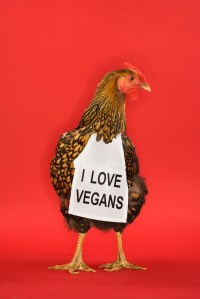
Chicken wearing funny vegan sign.

Are you now, or have you ever been a member of the Veganist Party? 

The land of the fruited plain and the home of the Atlanta Braves® knows what’s for dinner — boeuf. This place is always open for business. American students may not be able to locate India on a world map, but they know how to form a turkey by circumscribing the human hand.  Put it on the refrigerator and talk about the two (2) turkeys who will be pardoned this November.

vicious.vegan

Believe a whopper. Eat a Whopper®.

The Pilgrims arrived at Plymouth Rock to escape persecution (and to spread their own form of persecution). They invited savages (Native Americans) to dinner, the savages brought something hitherto unknown to Europeans — wild turkey. But the savages with red skin (just like the football team) turned on those settlers. Ungrateful beasts, behaving like animals.

Pop quiz: what is an Indian giver?

On September 1, 1914 the last Passenger Pigeon died in captivity. Unfortunately the pigeons were tasty fowl that dropped to the ground when you shot at the sky. Dress them for dinner.

Needlepoint project: “A Passenger Pigeon in every pot.” Good luck students!

The American Bison numbered thunderous thousands. Print the photograph of a mound of bison skulls for your refrigerator door.

bison.skulls.1870s
From Smithsonian.org. This is not a photoshopped image. Would that it were.

American ingenuity solved the extinction problem by creating the factory farm.

If those silly Hindus would eat the sacred cows walking and defecating in the marketplace, no one would starve in India.

Philip Morris® purchased Kraft Foods® in 1985. Both industries are in the addiction business, so it was a good marriage. Cigarette companies know much about carving out markets and expanding them. Japanese women don’t smoke? Make them customers. Chinese women don’t smoke? Make them customers.

Nestlé®owns Hot Pockets® Eat them for breakfast, lunch, dinner and middle-of-the-night craves.

hot_pocket

Kraft® owns Lunchables® Throw Lunchables® into your shopping cart after a frenetic day at the office. Throw them in by the fistful. You ate the Lunchables® that the kids wouldn’t eat while you were working. You didn’t break for lunch, but the lunch will probably break you.

What about the customers who become too grown up for your product? Carve a new niche that keeps ’em buying. Choosy Jif® mothers read magazine ads.

The more you waste, the greater the gross national product — by definition.

Thanks for reading.