German Grammar in the Everyday Every Day

Fashioning a German Lesson Plan from Anything at Hand

Class topic of the day (des Tages): how picking up a plastic bag off the street and reading the language printed on that bag may help you learn language. The one I have here is your classic bad-news-for-the-environment plastic bag. I retrieved one for each of you, so it’s a handout. Later in the day you can three-hole punch this handout and put it in your binder under today’s date.
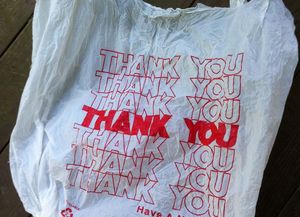
handout
Your handout for this class: Let’s say I had snagged this bag from under a parked car in the Kröger lot, before the plastic could pose a wildlife hazard. Now it’s in the lesson plan as an instructional resource. Note: 3 holes have not yet been punched. Please include margin notes using your felt-tip pen. Thank You. THANK YOU.

Today’s exercise allows you to use innate perceptual senses to discern meaning from everyday texts, and to discover potential contexts for your favorite words. Remember that new knowledge is fragile knowledge, so be gentle with yourself and feel free to make mistakes. In this class the student who makes the most mistakes gets the highest mark since she learns from her own mistakes. Also, if the present-moment reader finds an error in this post I get a point.

Use this bag later in your life for sandwiches, knickknacks, sturdy water bottles and items with words written upon them.

Anyway, pick up your red Sharpie and write ‘rot‘ on the handout. Think about how similar ‘t’ and ‘d’ sound: “Ta Da!” and recall the apocryphal tale of Saxons (Sachsen) moving to England to start a new language. On that hypothetical boat Saxons decided to change their ‘t’ to a ‘d’ and say ‘good‘ rather than ‘gut‘ and day instead of ‘Tag‘. And then call it English.

migration routes around 800 C.E.

Draw a rainbow with your Sharpies and label each color separately in your language of choice or else in German. Gather the things you want to put in your handout. Label that bag with its contents, z.B.:

  • Apfel (grüner)
  • Brot (rotes)
  • Papier (weißes)
  • Banane (gelbe oder grüne oder schwarze oder schwarzgelbe oder oder oder)
  • Apfelsaft (süßer)

Now place each object (each noun) into the bag (in die Tüte) and take a walk (einen Spaziergang machen). Connect the Umlaut dots atop the ‘u’ to form an ‘o’, thus reminding you just how crafty those dang Saxons were (Tüte becomes tote). Those tapfere Sachsen even simplified the ‘chs’ in their former German language to an ‘x’ in the new language (nächste becomes next).  While on this relaxing stroll let your friends (strangers optional) know about the contents of your bag:

Hallo. Hier in meiner Tüte habe ich einen grünen Apfel. Gebrauchtes Papier ist immer das Beste. Glaubst du das.

Let’s say you forget to bring your own shopping bag to Kröger. At least save those plastic hazards in your vehicle or Rücksack and drop them into the fiber recycling drum in their foyer (the place where you grab a shopping cart).

Thinking about Arabic, Farsi, Hebrew, Gießen and Savak

The culture where I live does not seem particularly interested in learning foreign languages. But the written, the spoken, and the audible become a part of the soul and a blessing to humanity when civilized thought can gain a foothold.
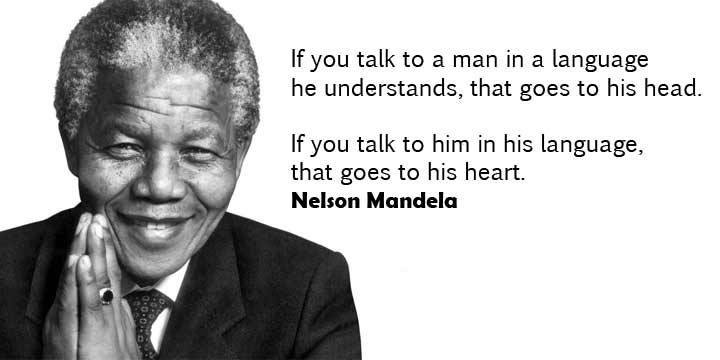
Nelson-Mandela-on-Language

My interest in German language led to an opportunity for study in Giessen, at that time West Germany, from 1971 to 1973. Upon arriving at Justus Liebig Universität I learned German as a second language with fellow students from Iran, Japan, Egypt among others. German was the tongue we shared, so that we could talk to the brain. Then we could join the citIzenry and talk to the heart.

Abteilung der Uni
Just be natural! It’s important when learning languages

Some people take on an alternate identity to ward off conversation. It was common for Americans traveling in Europe in the early 1970’s to attach a Canadian maple leaf to their person. This to avoid conversations about Vietnam. It was convenient to merge into the background. But such maneuvers may lead to a false sense of comfort: ease and convenience have long-term consequences. It is just as convenient to avoid discussions on long festering Middle East issues today. Are the sound bites you hear from a source without an agenda? Unfortunately, the truth can be hidden, often deliberately by perpetuating lies that simply make life more convenient or comfortable for the liar.

Under Mohammad Reza Pahlavi (Shah from 1941 to 1979) many Iranians studied at German universities such as Justus Liebig. Our Iranian fellows shared an ability to converse in German about Savak and the Persian experience. Neither Farsi nor English was necessary to bridge a gulf separating us from each other. Who knew that Pahlavi was complicit in dark matters. The Iranian people knew.

Farsi Keyboard
Farsi script is so similar to Arabic!

Guy Wallace explains Savak.

Imagine a monarchy that is 2500 years old, that began with Cyrus the Great and ended with Mohammad Reza Pahlavi’s deposition. Might a civilization both ancient and modern have evolved a complex history and culture In 2.5 millenia? Might Farsi hint at subtleties in the Persian soul? What about the country name itself: Persia, Iran? Does its religion suggest potential geopolitical significance? Can we question the translation of the colloquial Farsi into English of the conveniently repeated  Death to America (More accurately translated as Down with America).

Farsi speakers use this invocation to express transitory frustration, perhaps at stubbing a toe. In a future post I want to discuss the nature of curse words in Farsi, Arabic and Hebrew. Stay tuned.

Vegan Nuttables: Look for the Raccoon

Full disclosure assurance applies, just as it has with my Nittha Siam Kitchen review: this is an unpaid five-star rating. I like their stuff and I support them.

I found Once Again at Barney Kroger’s Grocery the other day and enjoyed the heck out of it. Recommended for a number of reasons: employee-owned, genuinely organic, label does not say

Naturally it’s flavored! Naturally it’s colored!

Their products are value-priced and feature raccoons. Bonus points: Once Again actually rescued raccoons on the premises. You can read about that on their website. Take a break now and shop for good edibles.


Use the Hot-Pockets-litmus-test: compare and contrast chemicals consumed. Billziegler1947 has already done the research for you. Analyses in the billziegler1947 laboratories have found that Hot Pockets do not strictly follow USDA Certified Organic guidelines.

For homework read the following before going food shopping.


Every time you eat or drink, you are either feeding disease or fighting it.

A fun place to visit vegan videos: FullCircleVegans and here’s a bonus: it’s also a WordPress blog. They’re also on Instagram and everything else.


Joseph Goebbels: Nazi Rules for Jazz Performers

Joseph Goebbels, Minister for Propaganda in Hitler’s Third Reich (appointed 1933) had a way with guidelines. A well written article on Goebbels’ thoughts on jazz links below.

Editor’s note for the easily cognitively dissonanced: inclusion of this list in this blog does not represent approval of Minister Goebbels.

Josef Skvorecky on the Nazis’ Control-Freak Hatred of Jazz from The Atlantic January 3, 2012 by JJ Gould.

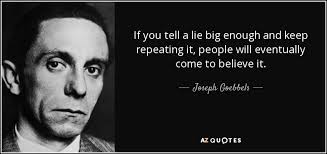
joseph_goebbels_quote

But if you want to get straight to the rules, Josef Skvorecky enumerates in the link above:

1. Pieces in foxtrot rhythm (so-called swing) are not to exceed 20% of the repertoire of light orchestras and dance bands.

2. In this so-called jazz type repertoire, preference is to be given to compositions in a major key and to lyrics expressing joy in life rather than Jewishly gloomy lyrics;

3. As to tempo, preference is also to be given to brisk compositions over slow ones (so-called blues); however, the pace must not exceed a certain degree of allegro, commensurate with the Aryan sense of discipline and moderation. On no account will Negroid excesses in tempo (so-called hot jazz) or in solo performances (so-called breaks) be tolerated;

4. So-called jazz compositions may contain at most 10% syncopation; the remainder must consist of a natural legato movement devoid of the hysterical rhythmic reverses characteristic of the barbarian races and conductive to dark instincts alien to the German people (so-called riffs);

5. Strictly prohibited is the use of instruments alien to the German spirit (so-called cowbells, flexatone, brushes, etc.) as well as all mutes which turn the noble sound of wind and brass instruments into a Jewish-Freemasonic yowl (so-called wa-wa, hat, etc.);

6. Also prohibited are so-called drum breaks longer than half a bar in four-quarter beat (except in stylized military marches);

7. The double bass must be played solely with the bow in so-called jazz compositions;

8. Plucking of the strings is prohibited, since it is damaging to the instrument and detrimental to Aryan musicality; if a so-called pizzicato effect is absolutely desirable for the character of the composition, strict care must be taken lest the string be allowed to patter on the sordine, which is henceforth forbidden;

9. Musicians are likewise forbidden to make vocal improvisations (so-called scat);

10. All light orchestras and dance bands are advised to restrict the use of saxophones of all keys and to substitute for them the violin-cello, the viola or possibly a suitable folk instrument.

joseph goebbels