Joseph Goebbels: Nazi Rules for Jazz Performers

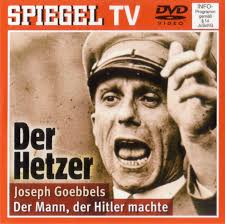
Joseph Goebbels, Minister for Propaganda in Hitler’s Third Reich (appointed 1933) had a way with guidelines. A well written article on Goebbels’ thoughts on jazz links below.

Editor’s note for the easily cognitively dissonanced: inclusion of this list in this blog does not represent approval of Minister Goebbels.

Josef Skvorecky on the Nazis’ Control-Freak Hatred of Jazz from The Atlantic January 3, 2012 by JJ Gould.
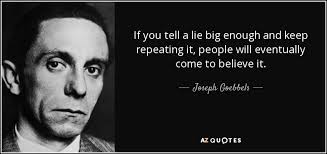
joseph_goebbels_quote

But if you want to get straight to the rules, Josef Skvorecky enumerates in the link above:

1. Pieces in foxtrot rhythm (so-called swing) are not to exceed 20% of the repertoire of light orchestras and dance bands.

2. In this so-called jazz type repertoire, preference is to be given to compositions in a major key and to lyrics expressing joy in life rather than Jewishly gloomy lyrics;

3. As to tempo, preference is also to be given to brisk compositions over slow ones (so-called blues); however, the pace must not exceed a certain degree of allegro, commensurate with the Aryan sense of discipline and moderation. On no account will Negroid excesses in tempo (so-called hot jazz) or in solo performances (so-called breaks) be tolerated;

4. So-called jazz compositions may contain at most 10% syncopation; the remainder must consist of a natural legato movement devoid of the hysterical rhythmic reverses characteristic of the barbarian races and conductive to dark instincts alien to the German people (so-called riffs);

5. Strictly prohibited is the use of instruments alien to the German spirit (so-called cowbells, flexatone, brushes, etc.) as well as all mutes which turn the noble sound of wind and brass instruments into a Jewish-Freemasonic yowl (so-called wa-wa, hat, etc.);

6. Also prohibited are so-called drum breaks longer than half a bar in four-quarter beat (except in stylized military marches);

7. The double bass must be played solely with the bow in so-called jazz compositions;

8. Plucking of the strings is prohibited, since it is damaging to the instrument and detrimental to Aryan musicality; if a so-called pizzicato effect is absolutely desirable for the character of the composition, strict care must be taken lest the string be allowed to patter on the sordine, which is henceforth forbidden;

9. Musicians are likewise forbidden to make vocal improvisations (so-called scat);

10. All light orchestras and dance bands are advised to restrict the use of saxophones of all keys and to substitute for them the violin-cello, the viola or possibly a suitable folk instrument.
joseph goebbels

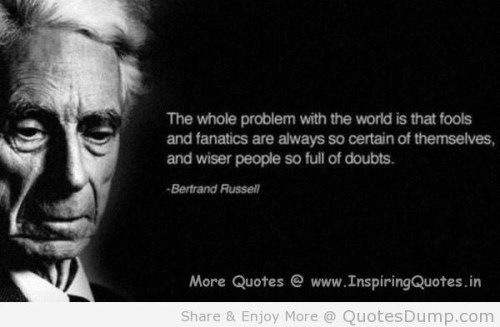
Nice People Explained: Bertrand Russel

I first read Bertrand Russell’s essay collection Why I am not a Christian In the early 70’s. One essay that affected me in particular, and that still intrigues me is Russell’s “Nice People.”

Skeptics Guide to the Universe Forum excerpt:

— Quote from: “Mike Foster” —I’ve been reading Why I Am Not A Christian, And Other Essays by Bertrand Russell. In it, he launches a fairly sarcastic – even scathing – attack on ‘nice people’ in a c1931 essay called . . .’Nice People’! He talks about people who think they are nice as often indirectly selfish, unappreciative, aloof, deceptive and inclined to exercise power indirectly through gossip etc.

It’s been a few years since this essay was published, but I am quite humbled at its timeliness. A great touchstone indeed.

Bertrand Russell

“Nice People” rather reminds me of Jonathan Swift’s bombastic apologist in Gulliver’s Travels. Swift’s finely pompous character is merrily describing the land of his birth. His pride at its prowess is figuratively exceptional: sufficient to pop his vest buttons, had he been wearing a vest. Let’s imagine they are gold buttons to polish the metaphor. So he extols the virtue of his beloved British Empire at considerable length. Russell waits, as did Swift, until the very end of his writing before telling us the salient distinguishing feature of these very nicely described Nice People. Unfortunately, they have nasty minds.

Thanks for reading.

Inexplicable Discrimination

مرحبا (Hallo),

The word for today’s class is “inexplicable.” Let’s get some قهوة عربية (arabischen Kaffee) and try to understand why news stories should be read with discrimination and not with discrimination.

Hey man, look at this crazy crap. There’s a cow on the news right now and it’s walking down the expressway. Is that like something you’ve ever seen ever? It’s like a North Korean spotted anywhere outside North Korea: an escapee from an authentically horrible place. A possible location of said cow using Google Maps: buildings densely populated by bovines. You are responsible for finding two (2) similarly inexplicable matters.

Doctors make house calls in Cuba, infant mortality is low, education is free, something about literacy rates and a cartoon character. What do my fellow Americans know about Cuba, its culture, its history?

Time for a Google search, exact phrase: “most moral army in the world”. Find a sentence that incorporates all six (6) words. For example, here is one such result from Haaretz (March 3, 2014): “The most moral army in the world fired an anti-tank missile at the house in which a wanted young Palestinian was hiding. The most moral army in the world ran a bulldozer over the top of the house and destroyed it.” I subscribe to Haaretz, so this article may not be available to you. Now, to stay on task, consider usage: inexplicable or explicable.

Class assignment: clip stories from your local newspaper about police officer heroes. Compare to episodes of The Wire. Consult this database maintained continuously and meticulously by The Guardian:

People killed by Police in 2015

You may also view the following video from Australian journalists that might pique your interest and provide examples of the “inexplicable.” It’s 53 minutes long. Remember that my quiz questions may come from anywhere in the video. If you are not a member of this class you do not have to view it. It’s here for its value; however images of gross child mistreatment are always disturbing:

Stone Cold Justice

The following link is provided as extra credit or for students majoring in the Israel-Palestine Conflict (1948 to present):

Electronic Intifada


Menschheit (Humanity)

Today’s topic is humanity and crimes against humanity. As I was putting this together, Jimmy Carter was being interviewed on The Diane Rehm Show. What a Mensch! More tomorrow..

Hamza Namira is an Egyptian singer, songwriter, and multi-instrumentalist. Namira sings on Arabic modern culture, discussing relevant social and humanitarian issues through his songs.

Egypt radio bans popular singer Hamza Namira for ‘critical’ songs

Here is one of those ‘critical’ songs:

Insan

And now a visit to Friends of the Israeli Defense Forces by Jewish Voice for Peace, first, from July 2014, a video:

JVP Protest at Friends of the IDF

Then a memory from Ferguson, MO. In the likely event of a possible misreading, the Nixon referred to below is Governor Jay Nixon. My excerpt is from the August 24, 2014 issue of the online article in BeMagazine.org original article on Ferguson is in Mother Jones.

Stay Human
Humane T-shirt

JEWISH VOICE FOR PEACE: ON MONDAY, HEDY EPSTEIN, A 90-YEAR-OLD HOLOCAUST SURVIVOR, WAS ARRESTED FOR “FAILURE TO DISPERSE” WHILE PROTESTING NIXON’S DECISION TO BRING THE MISSOURI NATIONAL GUARD TO FERGUSON. SHE’S A MEMBER OF JEWISH VOICE FOR PEACE, A NATIONAL GROUP THAT ADVOCATES FOR EQUALITY FOR PALESTINIANS AND ISRAELIS. “I AM DEEPLY, DEEPLY TROUBLED BY WHAT IS GOING ON IN FERGUSON,” EPSTEIN TOLD NEWSWEEK AFTER HER RELEASE. “IT’S A MATTER OF INJUSTICE, AND IT’S NOT ONLY IN FERGUSON…THE POWER STRUCTURE LOOKS AT ANYONE WHO’S DIFFERENT AS THE OTHER, AS LESS WORTHY, AND SO YOU TREAT THE OTHER AS SOMEONE WHO IS LESS HUMAN AND WHO NEEDS TO BE CONTROLLED AND WHO IS NOT TRUSTED.”