Epictetus 55 – 135 C.E.

I mentioned touchstones in a previous post, I now touch another one: Epictetus, usually noted as a stoic philosopher. But that is a bit procrustean; there is much room for subtlety here. I am directing your attention to Epictetus’ timeless contribution to a more civil society. Those familiar with the serenity prayer will find a beacon. Blaze an internet trail for more.
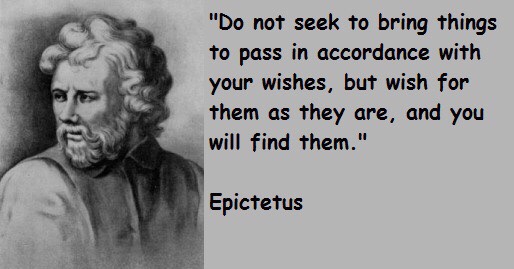


Do not seek to bring things to pass in accordance with your wishes, but wish for them as they are, and you will find them.


He is a wise man who does not grieve for the things which he has not, but rejoices for those which he has.


If thy brother wrongs thee, remember not so much his wrong-doing, but more than ever that he is thy brother.


The essence of philosophy is that a man should so live that his happiness shall depend as little as possible on external things.


There is only one way to happiness and that is to cease worrying about things which are beyond the power of our will.


To accuse others for one’s own misfortunes is a sign of want of education. To accuse oneself shows that one’s education has begun. To accuse neither oneself nor others shows that one’s education is complete.


We have two ears and one mouth so that we can listen twice as much as we speak.


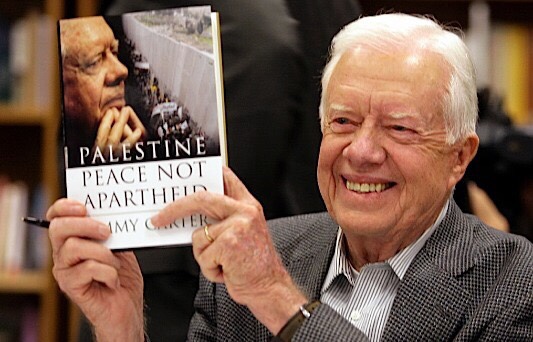
Jimmy Carter: the man with 20-20 foresight

Earlier this week I mentioned hearing Diane Rehm interview Jimmy Carter on her program. A Mensch with a capital M, and not just because it’s a noun. I also listened to an interview on Bob Edwards Radio (need to write about Bob too, another Mensch). This was about Carter’s so-called “Malais” speech: you can internet that phrase too. That speech did not contain that particular word, but team it with Reagan and recall “Morning in America” and you’ll get there from here.

Well, Jimmy was right on target and he has lived long enough to see us realize it. Selling off your valuable possessions such as your industrial base to those overseas places makes you look like a lottery winner in the short run. It takes you closer to Shirley Jackson’s Lottery in the long run. Also no wars during the Carter Administration. No solar panels on the White House roof after 1980. Jimmy Carter’s foresight was 20-20. And he has the courage to use words like apartheid in proper context: truth to power. Mourning in America.


Nice People Explained: Bertrand Russel

I first read Bertrand Russell’s essay collection Why I am not a Christian In the early 70’s. One essay that affected me in particular, and that still intrigues me is Russell’s “Nice People.”

Skeptics Guide to the Universe Forum excerpt:

— Quote from: “Mike Foster” —I’ve been reading Why I Am Not A Christian, And Other Essays by Bertrand Russell. In it, he launches a fairly sarcastic – even scathing – attack on ‘nice people’ in a c1931 essay called . . .’Nice People’! He talks about people who think they are nice as often indirectly selfish, unappreciative, aloof, deceptive and inclined to exercise power indirectly through gossip etc.

It’s been a few years since this essay was published, but I am quite humbled at its timeliness. A great touchstone indeed.

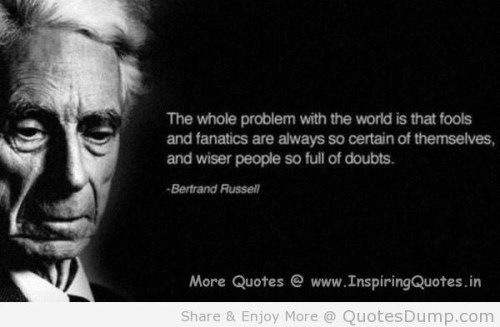
Bertrand Russell

“Nice People” rather reminds me of Jonathan Swift’s bombastic apologist in Gulliver’s Travels. Swift’s finely pompous character is merrily describing the land of his birth. His pride at its prowess is figuratively exceptional: sufficient to pop his vest buttons, had he been wearing a vest. Let’s imagine they are gold buttons to polish the metaphor. So he extols the virtue of his beloved British Empire at considerable length. Russell waits, as did Swift, until the very end of his writing before telling us the salient distinguishing feature of these very nicely described Nice People. Unfortunately, they have nasty minds.

Thanks for reading.

Inexplicable Discrimination

مرحبا (Hallo),

The word for today’s class is “inexplicable.” Let’s get some قهوة عربية (arabischen Kaffee) and try to understand why news stories should be read with discrimination and not with discrimination.

Hey man, look at this crazy crap. There’s a cow on the news right now and it’s walking down the expressway. Is that like something you’ve ever seen ever? It’s like a North Korean spotted anywhere outside North Korea: an escapee from an authentically horrible place. A possible location of said cow using Google Maps: buildings densely populated by bovines. You are responsible for finding two (2) similarly inexplicable matters.

Doctors make house calls in Cuba, infant mortality is low, education is free, something about literacy rates and a cartoon character. What do my fellow Americans know about Cuba, its culture, its history?

Time for a Google search, exact phrase: “most moral army in the world”. Find a sentence that incorporates all six (6) words. For example, here is one such result from Haaretz (March 3, 2014): “The most moral army in the world fired an anti-tank missile at the house in which a wanted young Palestinian was hiding. The most moral army in the world ran a bulldozer over the top of the house and destroyed it.” I subscribe to Haaretz, so this article may not be available to you. Now, to stay on task, consider usage: inexplicable or explicable.

Class assignment: clip stories from your local newspaper about police officer heroes. Compare to episodes of The Wire. Consult this database maintained continuously and meticulously by The Guardian:

People killed by Police in 2015

You may also view the following video from Australian journalists that might pique your interest and provide examples of the “inexplicable.” It’s 53 minutes long. Remember that my quiz questions may come from anywhere in the video. If you are not a member of this class you do not have to view it. It’s here for its value; however images of gross child mistreatment are always disturbing:

Stone Cold Justice

The following link is provided as extra credit or for students majoring in the Israel-Palestine Conflict (1948 to present):

Electronic Intifada